
When the trailer ABS lamp follows the brake pedal
A brief flash at each pedal application can point to how a trailer’s anti-lock brakes are getting power. The tractor and trailer pairing determines what that observation means.
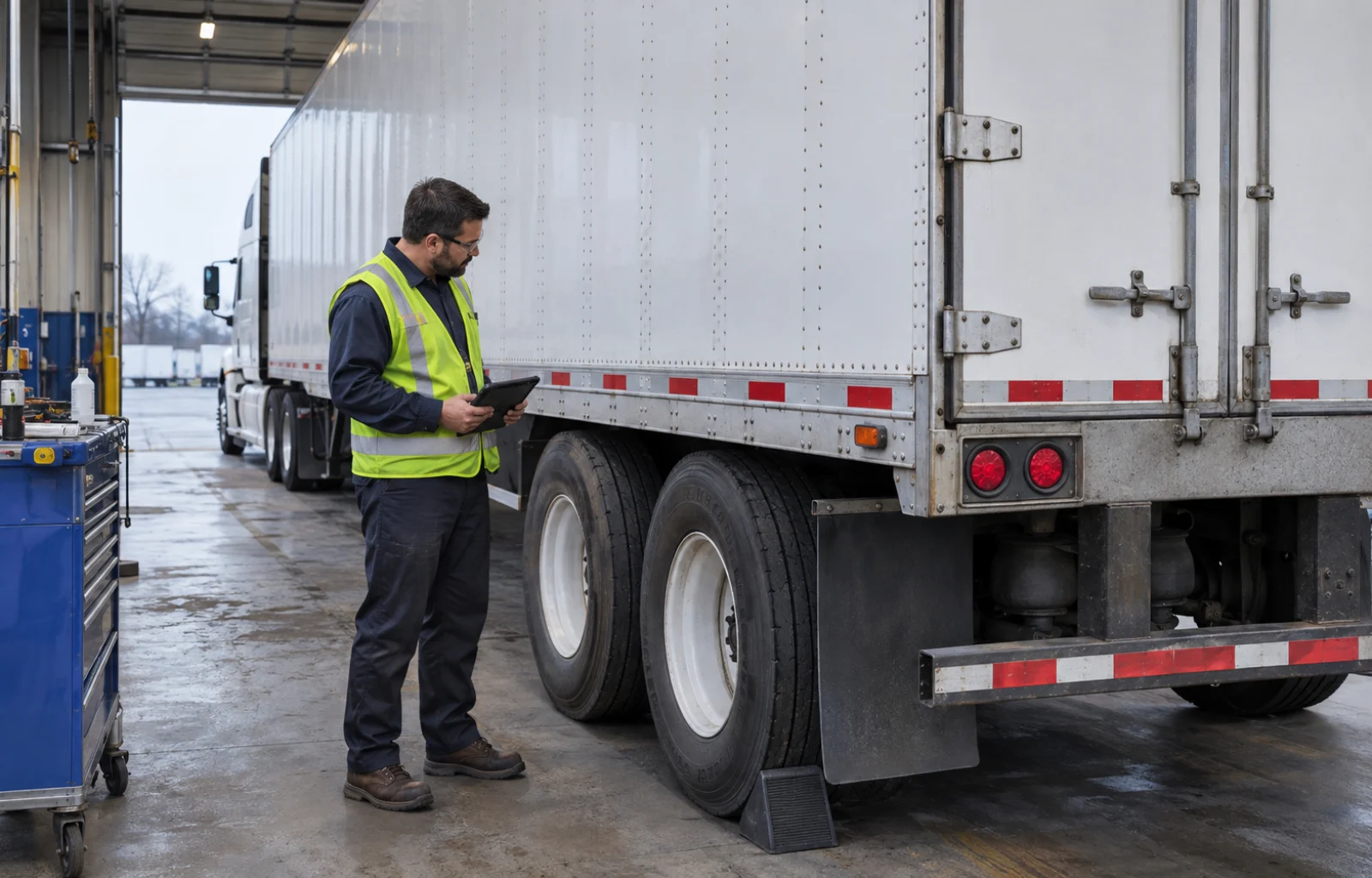
At a parked tractor-trailer, a driver notices that the amber ABS lamp at the rear of the trailer briefly lights each time the service brake pedal is pressed. The timing is a clue for the shop. The trailer’s anti-lock brake controller may be starting its self-check each time the stop-lamp circuit supplies power. Whether that is expected depends on the tractor pulling the trailer. The distinction matters for fleets that swap trailers between tractors or hand them off at another terminal.
Federal Motor Vehicle Safety Standard No. 121 spells out the power requirement in S5.1.6.3. Covered truck tractors built on or after March 1, 1997 must supply continuous power to the towed anti-lock system while the ignition is in the run position. The standard applies a March 1, 1998 threshold to covered single-unit vehicles equipped to tow air-braked vehicles. Separately, 49 CFR 393.55 requires an exterior ABS malfunction lamp on covered air-braked trailers built on or after March 1, 1998. Use the manufacture dates of the actual units. The separate March 1, 2001 requirements for communicating trailer ABS faults to an in-cab indicator do not set the start date of the power requirement.
The Commercial Vehicle Safety Alliance’s Vehicle Committee addressed this exact symptom in a case submitted in January 2026. The case cited a Bendix manual describing a short lamp cycle at each brake application on a stop-lamp-powered setup. The committee recorded the manufacturer’s explanation that the same cycle could indicate a problem with the primary power circuit or wiring on a combination that should be supplying continuous power. The controller can still provide anti-lock braking when powered through the backup circuit. The committee closed the case without recommending a change to its inspection guidance. The practical point for a fleet is that a lamp can perform its self-check and still reveal a problem with the way the combination supplies power.
Put that distinction into a hypothetical yard handoff. An older tractor built before the ABS power requirement may supply the trailer controller through the stop-lamp circuit when the pedal is pressed. A newer tractor required to supply power throughout ignition run should already be powering the controller before that first pedal application. A repeated trailer-lamp cycle tied to the pedal on the covered pairing deserves a power-supply assessment. Some combinations also supply full-time power, so a key cycle alone may fail to restart the controller for observation. CVSA has addressed those systems separately. The shop should use the procedure specified for the equipment and verify how the trailer is actually powered.
Industry sponsor Keep drivers, dispatch, safety, and maintenance working from one operating view.
Explore Pro FleetSync ↗
For the driver report, write down both unit numbers, which lamp you saw, the ignition state, and whether the light cycled at startup, with each pedal application, or stayed on. Those are observations a technician can try to reproduce on the same pairing. Our editorial recommendation is to record the combination before a trailer swap and have a qualified technician verify primary power through the tractor-to-trailer connection. If the behavior changes after a swap, preserve that comparison in the work order. The visible lamp is on the trailer, but CVSA’s earlier inspection clarification attributes a failure to supply required continuous power to the power unit. A symptom on the trailer can therefore send the shop to the tractor first.
Close the work order against the condition that prompted it. Ask which pairing was checked, whether primary power was available as required, and whether the applicable lamp check behaved as the manufacturer specifies. Replacing a lamp without establishing what powered the controller can leave the original question open. This resource explains how to describe the symptom and route it for evaluation. The carrier’s qualified personnel determine the equipment’s status under the applicable inspection and maintenance requirements.