
Secure the terminal entry without locking the exit
A badge-controlled entrance does not settle how employees escape. Review the inside release, the security alarm and the route beyond the door before changing terminal access.
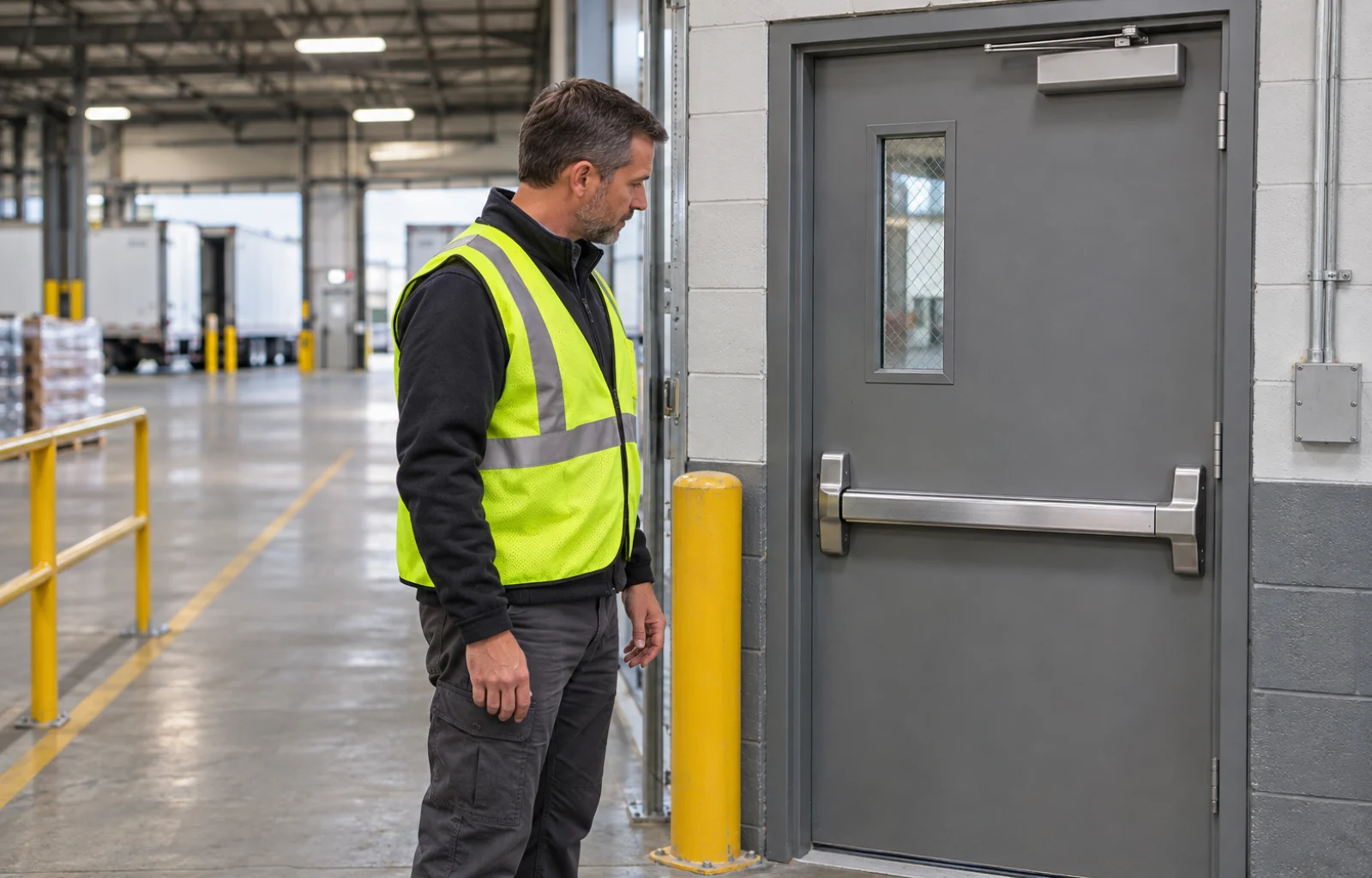
A terminal can restrict who enters after hours while people continue working inside. What happens when a dispatcher, technician or visiting driver needs to leave through an emergency exit? A working badge reader at the front entrance does not answer that question. This resource examines existing federal exit-route requirements and a documented OSHA interpretation, verified for this edition. It reports no new rule or incident. The focus is the inside release of a secured door, a specific review that matters across freight terminals and fleet shops nationwide.
OSHA section 1910.36(d) requires employees to be able to open an exit-route door from inside without a key, tool or special knowledge. A panic bar may secure an exit discharge door against entry from outside. Preventing unauthorized entry therefore does not require trapping the people already inside. The provision also addresses devices or alarms whose failure could restrict emergency use. Have the responsible facility specialist evaluate the actual hardware and applicable requirements. An access-control product being sold for commercial buildings does not establish its suitability for every exit.
A March 1981 OSHA interpretation makes the extra-step problem concrete. The installation described required an electronic device to be pressed before a panic bar would work. OSHA rejected that arrangement, explaining that a person escaping smoke might not find the device. The letter allowed a relay that reported opening to security without inhibiting departure. This is an interpretation of a particular arrangement, not blanket approval of modern electronic locks. Its useful question remains specific: does operating the exit hardware release the door, or must an occupant first perform another action?
Our editorial recommendation is to review an access change from both sides with the facility safety lead and qualified door or security specialist. Ask them to identify the exit function, demonstrate normal inside operation safely, and explain what happens if the relevant control or alarm fails. Do not ask employees to disconnect power or defeat a device as an improvised test. Record who evaluated the arrangement and which conditions were checked. A demonstration of badge entry alone leaves emergency departure unresolved, particularly when the overnight team has fewer people available to call.
Industry sponsor Connect the records, conversations, and follow-up that keep a carrier moving.
See how it works ↗
The review continues beyond the latch. Section 1910.37 requires clear exit routes, including freedom from temporarily placed materials and equipment, functioning safeguards, and adequate lighting and marking. A pallet staged for a few minutes still occupies space someone may need immediately. Our suggested walk follows the actual route from an occupied work area through the door to its discharge. Check during the shift that uses it, when freight staging and exterior parking may differ from the daytime arrangement. An illuminated sign cannot resolve a blocked path below it.
Keeping a door open is not a general solution to difficult hardware. The Canadian Centre for Occupational Health and Safety distinguishes emergency opening from the ability of fire doors to close, warning against obstructions that defeat closure. Its guidance supplies safety context rather than U.S. requirements. Refer a sticking door, added chain or unexplained release sequence for correction through the facility procedure. Do not wedge a fire door or invent a lock arrangement to make a shift run smoothly. Have qualified reviewers resolve the condition and any applicable building or fire-code questions.
For a hypothetical terminal adding badge access, useful closeout reaches beyond a successful entry scan. Reviewers should be able to explain inside release, failure behavior and the continuing clear route. Our suggested handoff names who receives a defect report and who confirms correction before people rely on the affected exit. These are editorial planning suggestions, not a federally prescribed checklist or complete building-code assessment. The practical result is security and operating staff agreeing on the same door: controlled entry with an emergency departure path people can use.