
A welding fire watch has to see beyond the bay
Sparks can reach another room, and a fire can smolder after the tools stop. A fleet-shop welding plan needs a defined watch area, a trained watcher and a deliberate closeout.
 Keep drivers, dispatch, safety, and maintenance working from one operating view.
Explore Pro FleetSync ↗
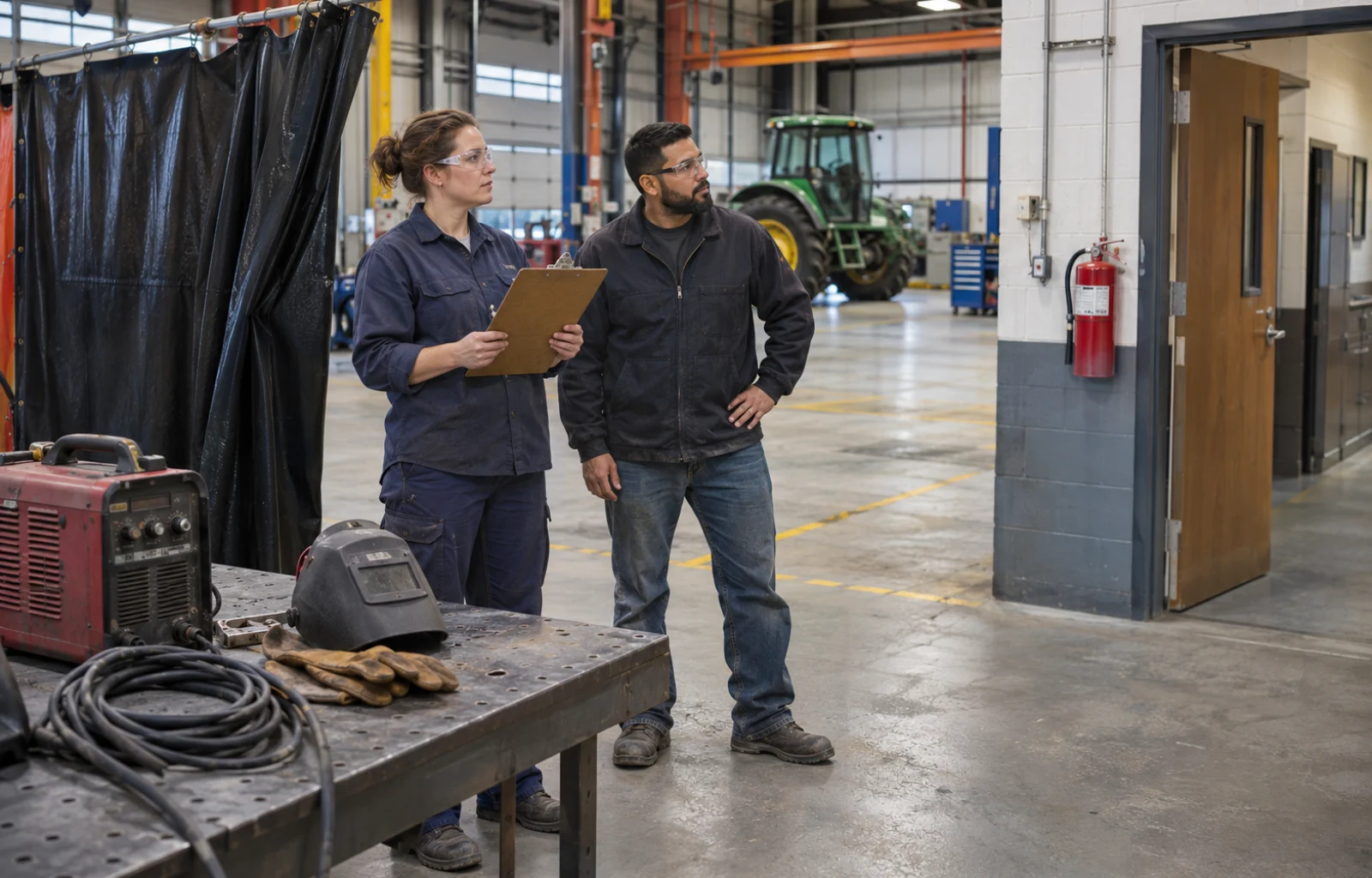
A repair can end at the workbench while its fire exposure continues on the other side of a partition. For fleet shops arranging welding or cutting, the useful planning question is who watches every exposed area and who remains after the tools stop. This resource applies existing fire-prevention requirements and technical guidance to that question. It reports no new rule or shop incident. The proposed planning record is editorial advice for a qualified safety reviewer to adapt to the actual workplace; it is not a welding procedure or permission to begin work.
OSHA’s general-industry section 1910.252 requires a fire watch where welding or cutting could produce more than a minor fire, and specifies several triggers. They include appreciable combustibles within 35 feet, easily ignited combustibles farther away, nearby openings exposing adjacent or concealed spaces, and combustible material across metal surfaces that heat could ignite. Watchers need readily available extinguishing equipment, training in its use and knowledge of the alarm arrangements. They watch all exposed areas, attempt extinguishment only when clearly within the equipment’s capacity, and otherwise raise the alarm. The watch continues at least half an hour after welding or cutting finishes. The section also requires area inspection by the person authorizing the work, with designated precautions preferably recorded in a written permit. Removing or guarding fire hazards remains necessary; if the basic precautions cannot be met, the work must not proceed.
That makes 35 feet a decision point rather than the edge of every possible exposure. Our suggested pre-job conversation starts at the proposed work location and follows where heat or sparks could go. Ask the authorizing person to identify adjacent spaces that need inspection and observation, rather than treating the painted bay boundary as the watch boundary. For a hypothetical repair beside a doorway, the question is what lies beyond it and who can see that space. This is a planning example, not evidence that a particular shop configuration is safe.
The Canadian Centre for Occupational Health and Safety offers useful supplementary guidance: its hot-work resource calls for attention to ducts, cracks and lower levels, including a trained watcher during breaks. It recommends at least 60 minutes of watching after work stops and potentially longer monitoring. Those recommendations should not be presented as the wording of the U.S. federal half-hour minimum. They show why a supervisor should establish the applicable duration before scheduling the job. Have the responsible reviewer check governing requirements, the site program and any additional obligations; a minimum duration is not a promise that every exposure has ended.
For a fleet manager, our editorial recommendation is to put the watch assignment on the same planning conversation as the repair assignment. Name the person responsible, the areas that must remain observable, the alarm method and how coverage continues during a break or shift change. If one person cannot see all the identified areas, have the authorizing reviewer resolve coverage before work starts. Do not assume an employee doing an unrelated job nearby has accepted the assignment or understands it. A contractor’s arrival should prompt that conversation with the site contact before anyone relies on the other company’s arrangements.
Build the after-work period into the schedule. Our proposed record has separate entries for the end of welding or cutting, the required watch duration, any additional monitoring and the person responsible for closeout. Those fields are a management suggestion, not a prescribed federal form. If the repair is scheduled near the end of a shift, settle who will remain before approving the start. A dispatch request for the repaired equipment does not answer whether the surrounding work area has completed its fire-prevention closeout. Keep equipment release and area closeout explicit so one cannot silently stand in for the other.
This review answers a different question from checking an extinguisher’s service tag, selecting eye protection or isolating a truck’s hazardous energy. Those controls still need their own assessment; none establishes where an ember might land or who notices a developing fire. The practical result should be an authorized job with understood boundaries, sustained coverage and a named finish decision. If the responsible people cannot explain that arrangement before the work, resolve the gap while the welding machine is still idle.