
Plan the support before the jack raises the truck
A jack’s lifting capacity does not settle the support plan for work beneath a vehicle. Review the load, support equipment and service history before the lift begins.
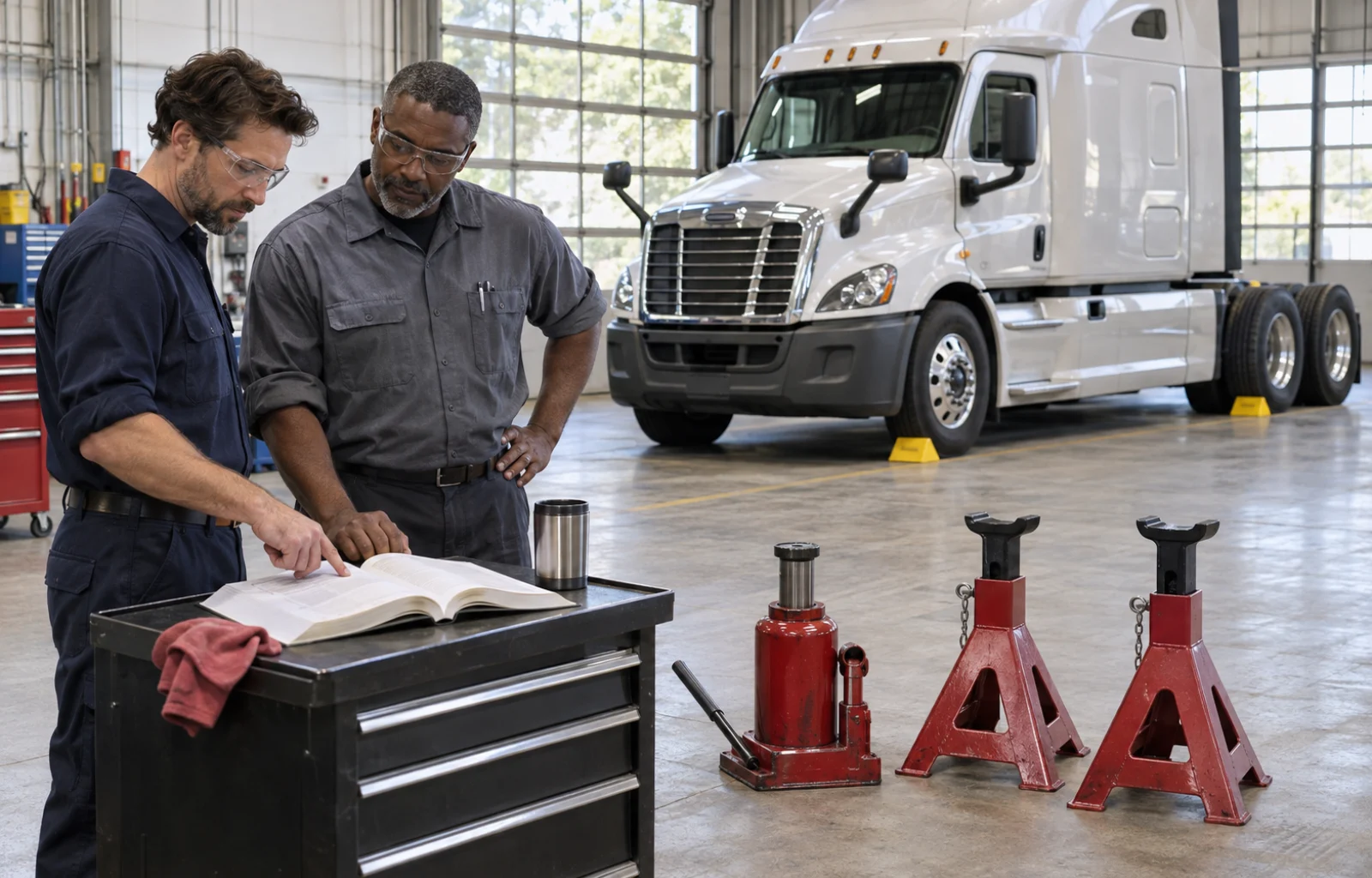
A truck that has reached the required working height has completed a movement, not proved that someone can safely work underneath it. For a terminal shop or mobile maintenance assignment, the unanswered question is what will support the vehicle during the job. This resource examines existing jack requirements and vehicle-repair guidance verified for this edition. It announces no new rule and does not supply a lifting procedure for a particular truck. The practical decision belongs before equipment takes the load: can the trained maintenance team identify a suitable lifting method and a separate, suitable support arrangement?
Federal OSHA’s general-industry jack provisions, 29 CFR 1910.244(a), require adequate rated capacity and a prominent, permanent, legible load marking. They address foundation and cap slippage, prohibit exceeding indicated travel, and require prompt securing of a raised load by blocking, cribbing or another method. Inspection frequency depends on service: for use at one locality, the minimum is every six months; special work away from the shop calls for inspection on dispatch and return; abnormal load or shock calls for inspection immediately before and after. Defective jacks must be tagged and withheld from use until repaired. These are existing federal provisions, not a new fleet inspection calendar.
The Canadian Centre for Occupational Health and Safety adds a useful equipment-use distinction: its garage guidance calls for a visual jack check before each use, manufacturer-specified lifting points and suitable safety stands when someone works below a vehicle. It warns against going beneath a vehicle supported only by a jack. That is technical guidance from Canada, not Canadian law imposed on a U.S. fleet. The recurring inspection and the immediate equipment check answer different questions. A recent inspection record does not establish that a jack has escaped damage since then, or that the proposed support fits this assignment.
Britain’s Health and Safety Executive likewise advises against relying on jacks alone. Its vehicle-repair guidance identifies firm, level ground, proper lifting points, capacity limits and correct stand pins as important controls. It specifically rejects substituting items such as bolts or screwdrivers for the proper pins. Its examples include a heavy-goods-vehicle fatality in which axle stands were available but unused. These are British guidance and incident accounts, not a U.S. legal standard or evidence of a new American incident. Their transferable lesson is that having support equipment somewhere in the shop is different from incorporating it into the actual work.
Industry sponsor Keep drivers, dispatch, safety, and maintenance working from one operating view.
Explore Pro FleetSync ↗
Our editorial recommendation is to put a support review into the job discussion before a technician reaches for a jack. Identify the unit and intended work, locate the applicable vehicle and equipment instructions, and have a qualified person resolve the required load ratings, contact points and support method. Do not infer capacity from a tool’s size or copy an arrangement from a different vehicle. This article deliberately supplies no universal placement diagram: the truck configuration and equipment instructions must determine the setup. If a marking cannot be read or the specified equipment is unavailable, pause the assignment and resolve that uncertainty.
Consider a hypothetical mobile service call using a jack borrowed from another bay. Our suggested handoff would establish its identity, condition and inspection history before dispatch, then confirm that the destination permits the planned work. A record saying that the tool returned to the shop does not describe what happened during the call. Ask whether it suffered a shock, overload or other reported problem, and route uncertainty to the person responsible for inspection. This proposed communication record is editorial guidance, not a federally prescribed form. It helps prevent an equipment concern from disappearing when a tool changes hands.
The useful finish to planning is a decision that the assigned team can explain: which applicable instructions govern the lift, what supports the vehicle during the task, and what equipment condition or site concern would stop the work? Keep this review alongside the employer’s other maintenance protections, including task-specific hazardous-energy controls. It does not replace them. Lifting equipment, support equipment and the people using both must fit the same assignment before anyone enters the danger area.