
Map the truck's energy before the repair starts
A repair order identifies the work. A safe shop handoff also identifies the electrical, mechanical, hydraulic, pneumatic, thermal, chemical, and stored energy that could reach the people doing it.
 Build stronger carrier workflows without another disconnected spreadsheet.
Meet Pro FleetSync - TMS ↗
Build stronger carrier workflows without another disconnected spreadsheet.
Meet Pro FleetSync - TMS ↗
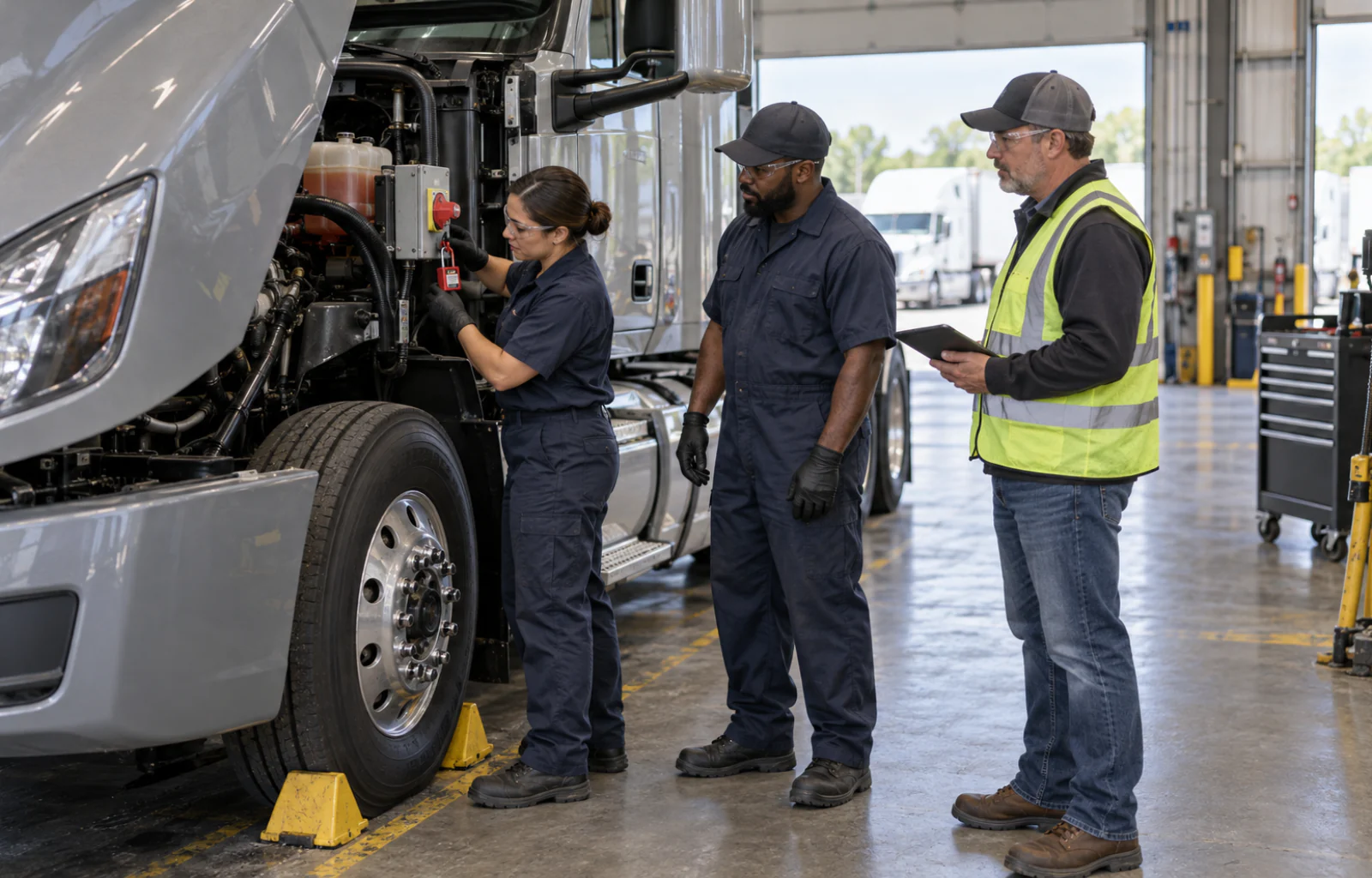
A repair order can identify a failed valve, an intermittent warning, a leaking line, or a scheduled service without answering the question that protects the people doing the work: what can still start, move, fall, pressurize, heat, or discharge after the truck is parked? Federal motor-carrier rules and workplace-safety rules address different parts of that problem. Section 396.3 requires a carrier to systematically inspect, repair, and maintain vehicles under its control and keep safety-related parts in proper operating condition. OSHA's vehicle-maintenance guidance separately says DOT rules address roadworthiness, while OSHA regulates the safety and health of employees performing maintenance. A useful shop handoff has to cover both lanes. This resource is editorial operating analysis, not a lockout procedure or legal advice for a particular vehicle, facility, or task.
Start with the actual exposure, not a slogan that every job is identical. OSHA's hazardous-energy standard applies to servicing and maintenance when unexpected energization, startup, or release of stored energy could injure an employee. Its definition of energy includes electrical, mechanical, hydraulic, pneumatic, chemical, thermal, and other sources. An OSHA interpretation addressing motor vehicles says an ignition key and disconnected battery cable may eliminate unexpected energization when stored-energy exposure is not present, but it also says every maintenance and diagnostic activity must be addressed in the employer's energy-control plan and that additional protection is necessary where stored energy can cause injury. The practical question is therefore not whether a truck has a key; it is which hazards the specific job and configuration create.
Build the intake around an energy inventory. Editorial inference: before assigning the work, connect the unit, complaint, planned task, and current configuration to the sources that could affect it. That review may include batteries and external electrical supplies; rotating or spring-loaded components; hydraulic or pneumatic pressure; hot fluids and surfaces; fuel or other chemicals; gravity acting on a raised cab, body, gate, axle, or attachment; and energy that can reaccumulate after an initial release. The list is not a substitute for the manufacturer's service information, an employer's procedure, or a qualified technician's judgment. Its value is making the handoff specific enough that a generic 'do not operate' note does not hide a second source or a changed configuration.
Put control with the people who are authorized to perform it. Section 1910.147 distinguishes an authorized employee who applies energy controls from affected employees who operate the equipment or work in the area and from other employees who may encounter the controlled equipment. Editorial inference: the driver, dispatcher, shop coordinator, and technician need a common status without pretending they have the same role. The driver can report observations and leave the unit in the agreed condition; the shop can decide which procedure and qualified people the task requires; dispatch can keep the equipment unavailable; and everyone nearby can understand that a lock or tag is not permission to test, move, or release the unit.
Follow the employer's task-specific sequence and verify the result. The OSHA standard calls for preparation, orderly shutdown, physical isolation through the needed energy-isolating devices, application of lockout or tagout by authorized employees, control of stored or residual energy, and verification before work begins. It also says push buttons, selector switches, and other control-circuit devices are not energy-isolating devices. Editorial inference: a key on a desk, a dashboard note, a work-order status, or a software flag can support communication, but none should be treated as proof that every hazardous source is isolated. The authorized employee must use the applicable procedure, equipment information, blocking or restraint, and verification method for the job rather than improvising from a fleetwide checklist.
Make testing and repositioning a controlled phase, not an informal exception. Some diagnostics require temporary energy or movement. Section 1910.147 provides a sequence for that situation: clear tools and materials, remove employees from the area, remove the energy-control devices as the procedure allows, energize only for the test or positioning, then deenergize and reapply the controls before service continues. Editorial inference: name that transition in the work order or shop communication so a technician, driver, or supervisor cannot mistake 'testing' for an unrestricted return to operation. The test has a defined purpose, responsible person, controlled area, and finish condition.
Plan the handoff across companies and shifts before it happens. When outside servicing personnel perform covered work, the OSHA standard requires the on-site employer and outside employer to inform each other of their lockout or tagout procedures, and the on-site employer must ensure its employees understand the outside procedure's restrictions. Group work must provide protection equivalent to personal control, and shift changes need an orderly transfer that preserves protection. For a carrier, those requirements expose three common boundaries: a mobile vendor entering the terminal, carrier employees working around a vendor-controlled truck, and a job that remains open when the first technician leaves. Editorial inference: assign one coordinator for each boundary, but do not let coordination replace each authorized employee's required control.
Separate return-to-service from removal of energy controls. Before energy is restored, section 1910.147 requires an inspection of the work area, confirmation that employees are safely positioned or removed, and notification of affected employees. It generally assigns device removal to the employee who applied it, with a documented employer procedure for the limited situation when that person is unavailable. FMCSA's maintenance rule separately requires records that identify the vehicle, the nature and due date of maintenance, and the date and nature of inspections, repairs, and maintenance. Editorial inference: the completed repair, the safe restoration of energy, and the fleet's dispatch release should be three explicit confirmations, even when one system records them on the same work order. Use the closed job to improve the next intake by identifying the reported condition, task, applicable energy-control procedure, any contractor or shift transfer, controlled testing step, completed repair, and person or role that released the unit. Do not copy technical lockout instructions into a generic dispatch note or let a vehicle-status flag substitute for the shop's procedure. Roadworthiness tells the fleet whether equipment may operate; energy control tells the maintenance team how people are protected while it cannot. A safe repair needs both decisions, in that order, with a clear handoff between them.