
Define the work at the forklift charging station
Charging a lead-acid forklift and servicing its battery are different assignments. A terminal needs to know which work actually happens before relying on a charging-only exception.
 Keep drivers, dispatch, safety, and maintenance working from one operating view.
Explore Pro FleetSync ↗
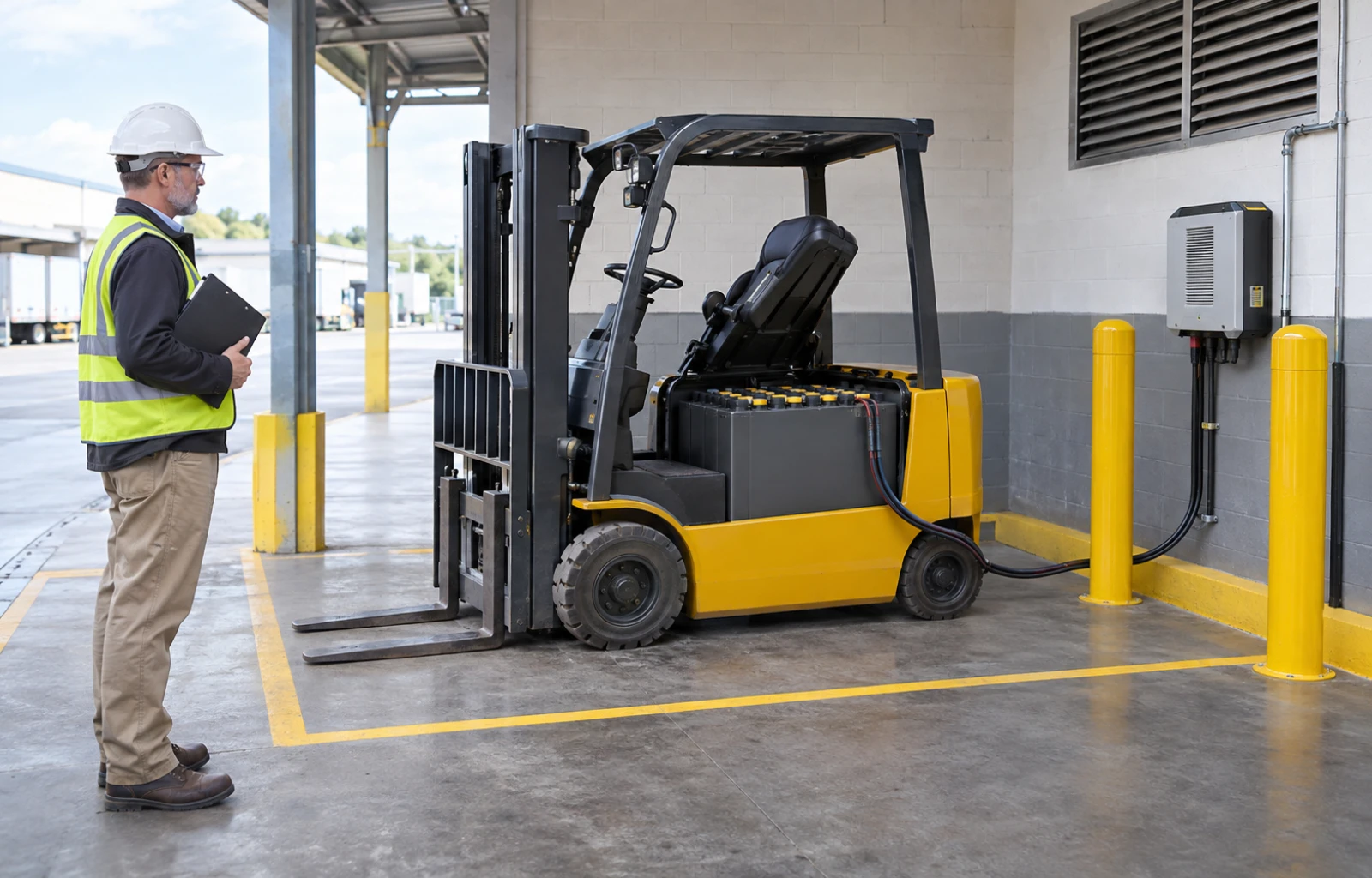
A freight terminal adds a charger beside the dock. Nobody plans to lift batteries there, so does the location need the same arrangements as a battery service area? The answer begins with the work actually performed. For fleets using lead-acid forklifts, OSHA has a specific charging-only interpretation, but its conditions are narrower than a sign saying “charging station.” This resource examines existing federal guidance verified for this edition. It does not announce a new rule or apply lead-acid procedures to lithium-ion equipment.
OSHA’s directive STD 01-11-004 describes areas where batteries are charged without maintenance, without removal from the trucks and without electrolyte present in the area. Those areas are outside the requirement of 29 CFR 1910.178(g)(2). The directive expressly retains several other charging provisions and requires PPE where applicable. Its practical significance is the boundary around the activity, not a general exemption for electric forklifts. A supervisor should not assume that a location still meets those conditions after someone begins battery servicing there.
The underlying standard requires designated charging locations. Paragraph (g)(2) addresses electrolyte-spill facilities, fire protection, protection of charging equipment against truck damage and ventilation for battery gases. Other provisions require positioning the forklift and applying its brake, functioning vent caps and open battery or compartment covers to release heat. They prohibit smoking, call for precautions against flames, sparks and arcs, and keep metal objects away from uncovered battery tops. A facility reviewing the directive should read those retained duties alongside it, rather than treating the exception as permission to improvise a charging corner.
The hazards explain why the distinction matters. The Canadian Centre for Occupational Health and Safety identifies hydrogen generated during charging and sulfuric acid in lead-acid battery fluid as central risks. It advises ventilation suited to the batteries being charged and manufacturer-approved charging devices matched to battery voltage and capacity. These are technical safety explanations, not Canadian legal requirements being substituted for U.S. rules. For a terminal adding more equipment, our editorial recommendation is to have the charging arrangement reassessed; yesterday’s space and airflow should not simply be assumed sufficient for a larger charging workload.
OSHA’s electric-forklift eTool recommends trained people for charging and battery changing, including preparation for an acid-splash emergency. It directs users to the facility’s procedures and charger manufacturer’s instructions for connections and operation. It also points to immediate emergency drenching or flushing facilities where corrosive exposure can occur. The operational question is therefore more useful than “Where is the plug?” Ask who may do which task, what instructions apply to this battery and charger, and what help is immediately available if something goes wrong. Reading this resource does not qualify someone to service a battery.
Consider a hypothetical change: a charging-only bay becomes the convenient place to add water, investigate a leak or remove a battery. Our editorial recommendation is to stop and obtain a qualified review before expanding the work. Document the permitted activities, identify the person responsible for assessing changes and make the boundary clear to each shift. Battery handling also introduces a heavy-load problem that a charger alone cannot solve. The useful terminal handoff is an agreed location and scope of work, with equipment and emergency arrangements selected for the actual exposure, before the next person starts.