
Count the forklift in the dockboard load
A pallet weight and a forklift lifting rating answer different questions. Before a dock crossing, establish what the bridge and trailer floor must actually support.
 From the road to the back office, keep every handoff visible.
Take a closer look ↗
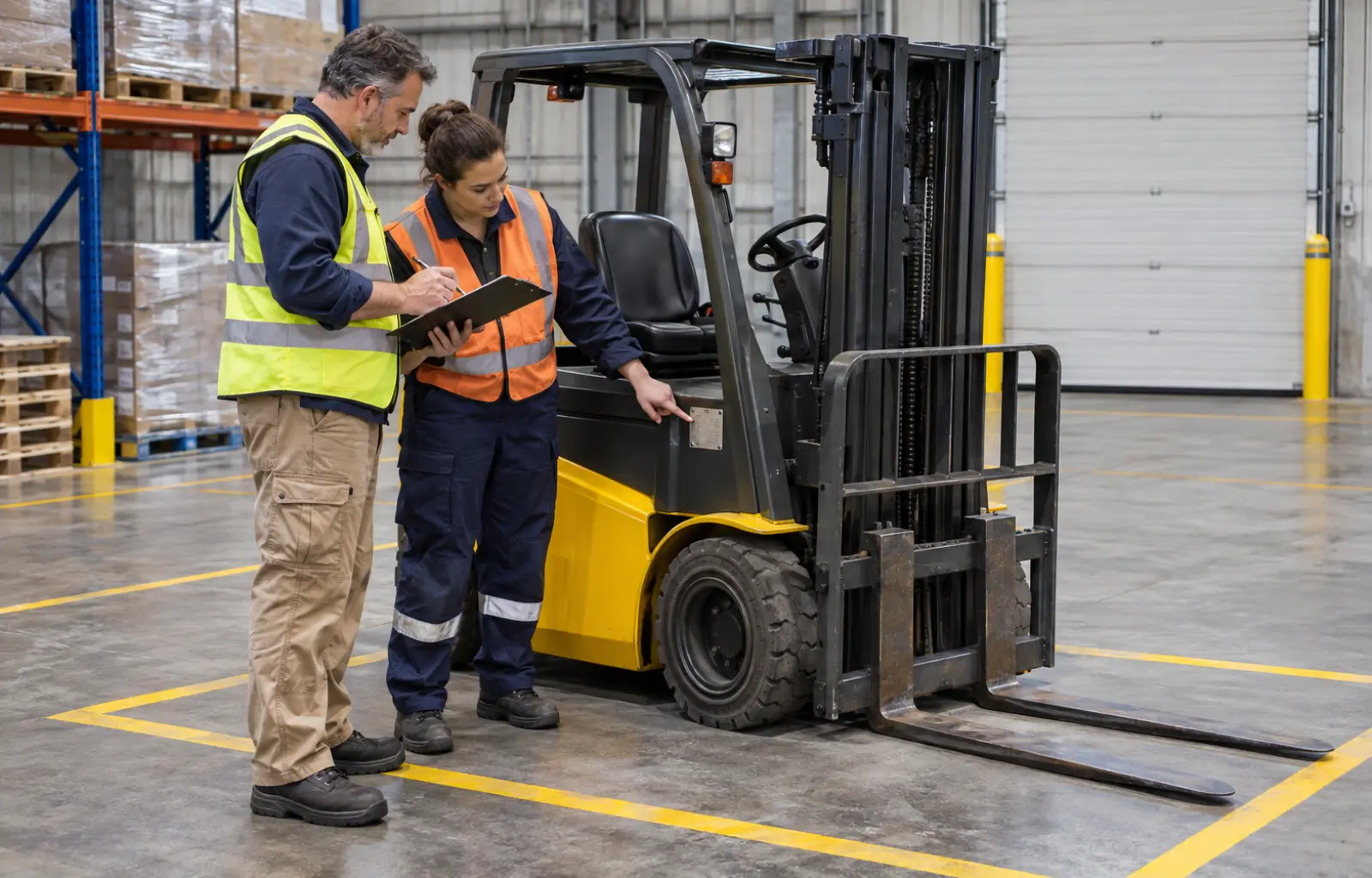
A pickup can be within a forklift’s lifting capacity and still leave an unanswered question at the trailer door: can the dockboard carry the machine as well as the freight? The pallet’s shipping weight is only part of what crosses the gap. This resource examines that distinction for U.S. carrier and terminal teams using current federal general-industry rules and safety guidance. It reports no new rule or incident. The worked example and suggested review process are editorial analysis, intended to help teams ask the equipment owner a precise question before accepting a loading arrangement.
OSHA’s 29 CFR 1910.26(a) requires dockboards to support the maximum intended load, referencing the walking-working-surface requirement in section 1910.22(b). A forklift’s lifting rating describes another limit. The Canadian Centre for Occupational Health and Safety explains that the lift truck’s data plate gives its load limit and that load positioning matters. That rating does not describe the truck’s own weight. Our practical recommendation is to keep the lifting-capacity decision and the crossing-capacity decision separate in a loading review, even when both involve the same pallet and operator.
Consider a deliberately simplified hypothetical: a forklift weighs 9,000 pounds in its working configuration and carries a 3,000-pound pallet. Those two items alone total 12,000 pounds. Comparing only the 3,000-pound freight figure with a dockboard rating omits most of this example’s weight. The arithmetic is an explanation, not approval to cross a particular board. The responsible equipment reviewer still needs to account for the operator, any other weight not included in the stated machine figure, and the manufacturer’s conditions for the particular dockboard and application. Do not treat a forklift’s rated lifting capacity as its operating weight.
CCOHS loading guidance explicitly calls for both the trailer deck and dock plate to support the combined forklift and load weight. It also calls for the plate to be properly positioned, levelled and secured, with its load weight clearly marked. This is technical safety guidance from Canada, not a statement of U.S. legal duties. Our recommendation for a changed loading plan is to identify the actual forklift, its working configuration, the freight and the specific crossing device. A different forklift may change the review even when the shipment has not changed. An unreadable rating is a question for the equipment owner, not an invitation to estimate from appearance.
Capacity also cannot establish that the board will stay in place. Section 1910.26 addresses securing portable dockboards, with a specified alternative when securing is demonstrably infeasible, and requires measures preventing the transport vehicle from moving while employees are on the board. It separately addresses run-off protection for dockboards put into initial service on or after January 17, 2017, subject to its stated exception. These are distinct requirements. A capacity number alone does not establish positioning, restraint or edge protection, and those controls do not supply a missing capacity determination. Have the responsible facility team resolve the complete arrangement.
An earlier successful crossing does not settle a newly observed defect. Section 1910.22 requires regular and necessary inspections, correction of hazardous surface conditions before reuse, and guarding when immediate correction is unavailable. Structural repairs require a qualified person to perform or supervise them. CCOHS additionally advises continuing to evaluate the trailer, dock plate and forklift and stopping when unsafe conditions develop. Our suggested response is to pause the affected crossing and report the actual equipment and condition through the facility procedure. Do not send someone across to prove that a doubtful board or floor will hold.
For a carrier arranging an unfamiliar pickup, a useful question is specific: who has confirmed that this forklift and load are suitable for this dockboard and trailer floor? The driver should receive a resolved handling plan rather than an unexplained assurance that the pallet is light. If the rating or configuration remains uncertain, our recommendation is to arrange review by the responsible qualified equipment personnel or change the handling method before work proceeds. This resource is not an engineering calculation or a complete compliance assessment. Its purpose is to keep the machine’s weight from disappearing between the freight paperwork and the dock.