
A safe air nozzle still needs a chip barrier
A fleet shop’s compressed-air cleaning check must cover the nozzle, flying debris and everyone nearby. A pressure rating alone cannot settle the task.
 Build stronger carrier workflows without another disconnected spreadsheet.
Meet Pro FleetSync - TMS ↗
A shop can buy a pressure-relieving air gun and still leave the next technician exposed to flying debris. The unanswered question is what the nozzle controls, and what remains for the cleaning setup to control. For fleet maintenance teams nationwide, the useful review is a task review rather than a purchase check: where can the particles go, who else can they reach, and what protection is in place? This resource explains existing general-industry compressed-air cleaning requirements verified for this edition. It describes no new federal rule and is not a guide to brake-system servicing or other uses of compressed air.
OSHA’s 29 CFR 1910.242(b) combines three conditions for cleaning: pressure reduced below 30 psi, effective chip guarding and personal protective equipment. Treat those as separate questions. The same standard makes employers responsible for the safe condition of employee-used tools, including employee-furnished equipment. Our practical recommendation is to review personal air guns alongside shop-owned ones. A tool arriving in a technician’s own box should not skip the fleet’s equipment review merely because purchasing never handled it.
The pressure question concerns the nozzle, including what happens when its outlet is blocked. OSHA’s published enforcement directive explains the static-pressure and dead-ending conditions; a compressor’s tank gauge alone does not describe them. The University of Montana’s safety guidance likewise explains that a pressure-relief arrangement can allow higher supply pressure while limiting pressure when flow is dead-ended. Ask the equipment supplier or qualified shop safety personnel to establish how the actual gun and nozzle meet the requirement. Do not improvise a test by pressing a nozzle against a hand, blocking relief ports or changing the tip to make the jet feel stronger.
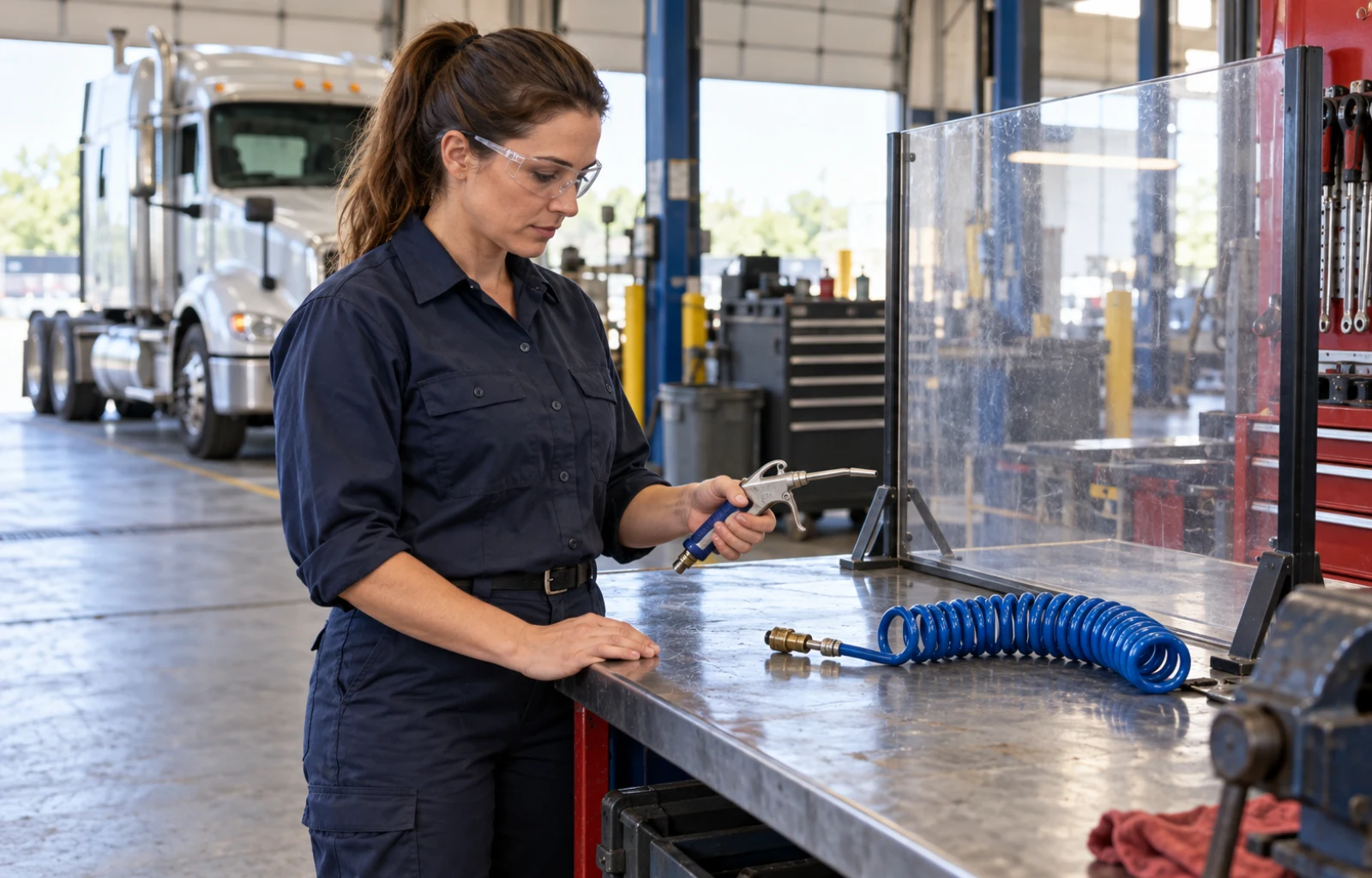
The second question follows the debris. OSHA’s directive describes guarding that prevents particles from reaching the operator’s or other workers’ eyes or unbroken skin. A protective air cone may protect the user yet leave someone beside the bench exposed; separate barriers, baffles or screens may be needed. The University of Montana repeats that distinction in its own guidance. Our suggested walk-through starts at the workpiece and follows the possible particle paths toward adjacent benches and walking routes. Assess the actual layout before calling the nozzle’s built-in protection sufficient.
Personal protection is the third check, not permission to omit guarding. Oregon OSHA’s compressed-air cleaning fact sheet calls for task-appropriate PPE and a hazard assessment, and discusses eye, hand and hearing protection. It also warns against using the air gun on the body or on clothing being worn, even at reduced pressure. That state guidance supports a useful shop conversation, while the federal standard supplies the general-industry baseline discussed here. Resolve the equipment and PPE selection against the material, task and applicable workplace requirements rather than declaring one set of glasses adequate for every cleaning job.
Consider a hypothetical bay where a technician clears particles from a bench while a coworker retrieves parts on the opposite side. A suitable pressure-relieving nozzle addresses one issue; it does not establish that the coworker is protected. Our recommended pre-task check records the gun and nozzle configuration, how debris is contained, the people potentially exposed and the selected protection. If the layout changes, revisit those answers. Ask whether another suitable cleaning method would avoid blowing particles across the bay, and have responsible safety personnel evaluate that option. The useful closeout is a cleaning arrangement that addresses all three conditions, not just an approved-tool sticker.