
A worn grinder wheel changes two safety gaps
A bench grinder can keep running while wheel wear opens its clearances. Check the work rest and upper guard separately before the next shop task.
 From the road to the back office, keep every handoff visible.
Take a closer look ↗
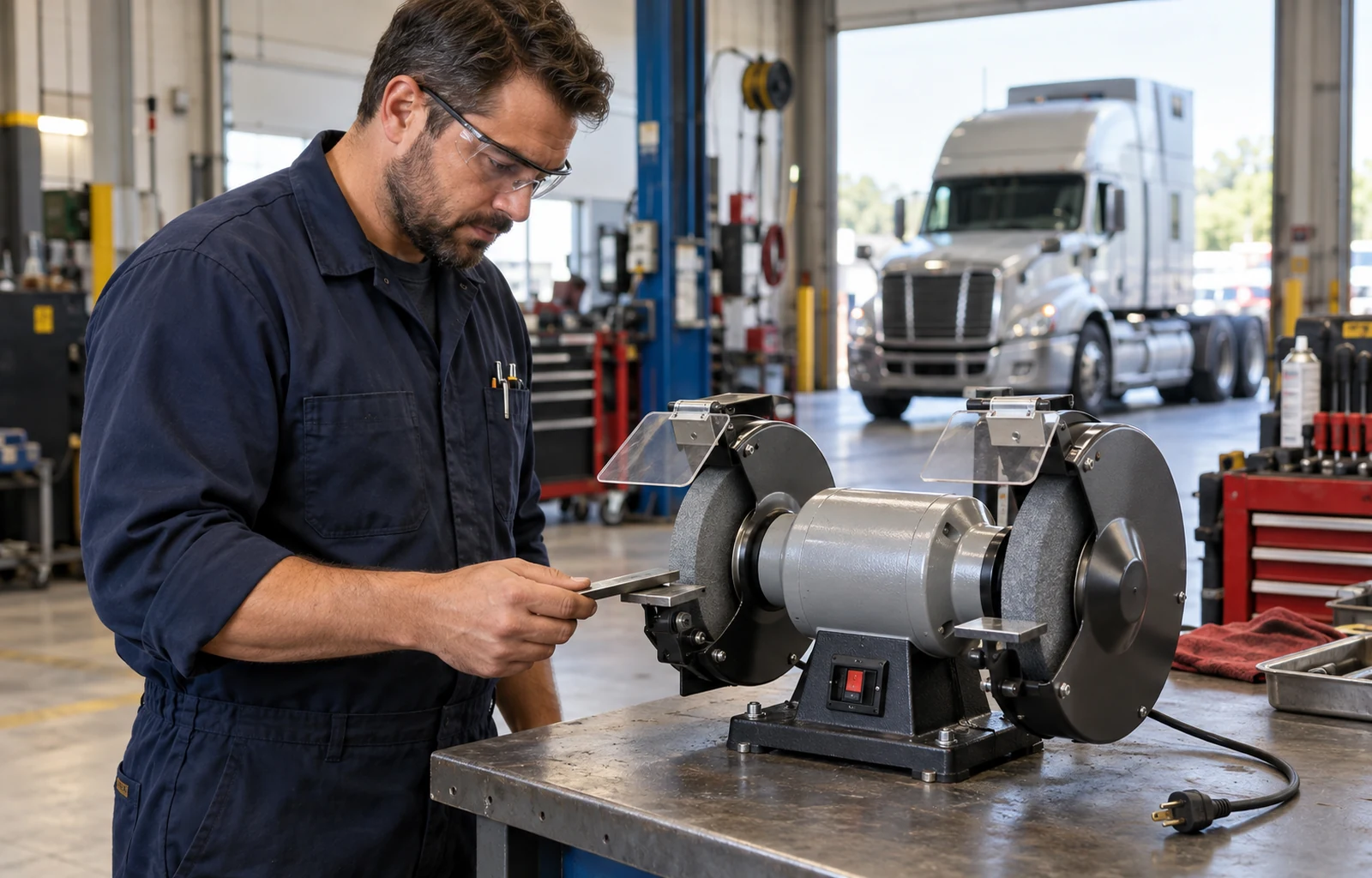
A bench grinder in a fleet shop may still start normally after its abrasive wheel has worn smaller. That does not mean its setup is still suitable. The wheel can retreat from both the work rest below the grinding area and the adjustable tongue guard above it. Those are separate clearances with separate limits. This resource applies existing federal general-industry requirements to ordinary bench and pedestal abrasive-wheel grinders; it reports no new rule or incident. The suggested shop review is editorial analysis, intended to help supervisors ask specific questions before another technician uses the machine.
Begin at the work rest, the rigid support for the piece being ground. OSHA’s section 1910.215(a)(4) sets a maximum opening of 1/8 inch between the rest and wheel. The purpose is to keep the work from becoming wedged in that space and potentially breaking the wheel. The rest must be adjustable for wheel wear and securely clamped after adjustment. Adjustment while the wheel is moving is prohibited. Our recommendation is to use an appropriate measuring aid through the shop’s established inspection process, rather than estimate the gap from the operator’s usual standing position.
Then check the upper opening independently. Section 1910.215(b)(9) requires the applicable guard arrangement to accommodate the wheel’s decreasing diameter and limits the gap at the adjustable tongue or upper peripheral member to 1/4 inch. Moving the work rest does not correct that upper opening. Oregon OSHA’s machine-safeguarding guide explains the different hazards: the rest supports the work and limits the trapping space, while the safety guard helps restrain fragments if the wheel breaks. Its grinder illustrations identify the two adjustment points separately. A check of only the lower support leaves an unanswered question at the top.
Treat a clear eye shield as another component, rather than proof that the wheel is adequately enclosed. Oregon OSHA specifically warns that transparent shields do not replace eye and face protection. The federal rule also says accessory visors do not count toward the guard opening unless they have equivalent strength. Our suggested review therefore asks three distinct questions: are the wheel guards appropriate, are both adjustable clearances within their limits, and is the required personal protection being used? A clean transparent shield cannot answer the first two. Follow the equipment instructions and the employer’s applicable procedures before measuring, adjusting or servicing the machine.
A replacement wheel introduces a different set of checks. OSHA requires inspection and a ring test immediately before mounting, along with a check that machine spindle speed does not exceed the wheel’s marked maximum operating speed. The rule notes that organic-bonded wheels do not produce the same clear metallic ring as vitrified or silicate wheels. This article does not supply a mounting procedure or a universal sound test for every wheel. Have the assigned person use the applicable wheel and machine instructions; a new wheel’s appearance or matching diameter alone does not establish compatibility. Oregon OSHA likewise directs users to follow manufacturer recommendations.
Make the outcome usable for the next person. Our proposed shop practice is to identify the grinder and affected wheel, record the two clearance checks, and assign any unresolved guard, adjustment or wheel question before the machine returns to use. If the proper clearance cannot be maintained with the existing parts and permitted adjustment, keep the grinder unavailable while the responsible person determines the appropriate correction. Do not improvise a guard or remove the rest to finish a small job. Recheck after relevant wheel work and as wear changes the setup, using the shop’s inspection schedule. The useful conclusion is that both openings were assessed on the present wheel, rather than that the motor ran yesterday.