
Battery relief still needs a vehicle-level load plan
A PHMSA rule taking effect September 3 raises the materials-of-trade allowance for lithium batteries, but eligibility, tested battery types, weight accounting, securement, hazard communication, and operator notice still have to travel with the truck.
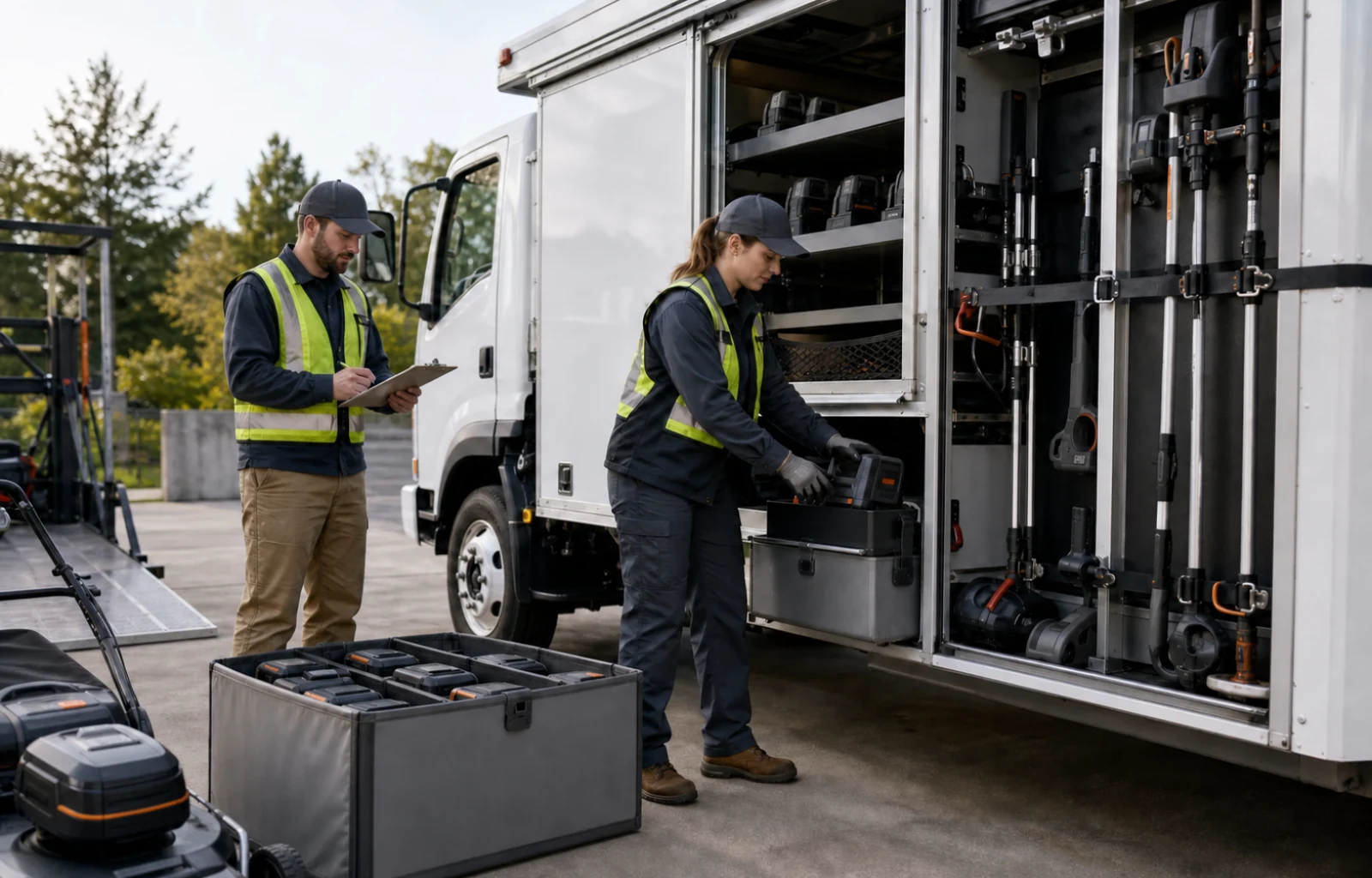
A higher battery allowance is useful only after a fleet establishes that the load qualifies for it. PHMSA published a final rule on August 4 that amends the materials-of-trade exception for lithium batteries beginning September 3. The change is aimed at businesses such as construction, landscaping, mowing, tree service, food service, and entertainment operations that carry battery-powered equipment in direct support of their work. It is not a blanket exception for anyone transporting batteries or equipment.
Start with the operating relationship. The materials-of-trade definition in 49 CFR 171.8 covers specified hazardous materials carried on a motor vehicle for purposes that include protecting the operator or passengers, supporting operation or maintenance of the vehicle, or, for a private motor carrier, directly supporting a principal business other than transportation by motor vehicle. A for-hire delivery of batteries is not transformed into a materials-of-trade movement merely because the shipment is small or travels in a service truck. The exact classification belongs with a qualified hazmat review; this resource is an operating framework, not legal or compliance advice.
For qualifying lithium cells and batteries, the revised text authorizes up to 30 kilograms, or 66 pounds, of net weight for each cell or battery and up to 500 kilograms, or 1,102 pounds, of aggregate net battery weight on a motor vehicle. Those two limits apply to cells and batteries that are not contained in equipment. PHMSA says batteries contained in equipment are not subject to those new quantity limits, while batteries packed with equipment still need to be counted. That distinction makes a vehicle-level inventory more useful than a rough estimate based on the number of cases in the truck.
The rule keeps a test gate. Cells and batteries, including those contained in or packed with equipment, must be of a type proven to meet the criteria in part III, subsection 38.3 of the United Nations Manual of Tests and Criteria. PHMSA says manufacturers must make a lithium-battery test summary available on request. Editorial inference: link each battery model in the approved-equipment list to the manufacturer or vendor record that confirms the tested design, then build the load record around what can change. Identify the vehicle, date, battery model, configuration, quantity, net weight, whether each battery is installed in equipment or carried separately, and who checked it. Total the batteries that count toward the 500-kilogram vehicle limit and flag any individual cell or battery approaching 30 kilograms. The physical load must still match the record after a tool swap, spare-battery addition, or midshift handoff.
Industry sponsor Connect the records, conversations, and follow-up that keep a carrier moving.
See how it works ↗
Connect the records, conversations, and follow-up that keep a carrier moving.
See how it works ↗
Securement is part of the allowance, not an optional warehouse preference. The amended rule requires cells and batteries, including those in equipment, to be packaged or secured to prevent short circuits, damage from shifting or placement, and accidental equipment activation. It also expressly allows outer packaging to be omitted when batteries are secured against shifting in cages, carts, bins, boxes, compartments, or by other means. Editorial inference: the loading check should examine terminal protection, movement in every direction, contact with metal tools, equipment controls, compartment latches, and what another crew could place on top of the load.
Hazard communication does not disappear when the weight ceiling rises. Under the amended text, a package exceeding 30 kilograms of net battery weight must carry the applicable Class 9 label and four-digit UN identification number. The motor-vehicle operator must be informed that a material of trade is present, whether a package contains a reportable quantity, and what the section requires. The fleet's load record should therefore trigger a review of the actual packaging and marking configuration instead of treating every battery bin the same.
Keep damaged, defective, recalled, prototype, and end-of-life batteries outside the routine load assumption. PHMSA describes damaged, defective, and recalled batteries as having greater potential to short circuit, release heat, or cause fire. The new rule does not add sodium-ion batteries, and PHMSA declined to extend the materials-of-trade treatment to untested prototype batteries in this action. A quarantine and escalation path helps prevent an unusual battery from being dropped into a normal spare-battery bin because it looks similar.
Use the weeks before September 3 to test one representative vehicle from end to end. Confirm why the movement qualifies, verify the battery designs, weigh or document the counted batteries, inspect the securement, check any required marks and labels, brief the operator, and compare the truck with the load record. Then repeat the check after a realistic equipment exchange. The practical benefit of the new limit is more usable battery capacity for the work; the control that makes it defensible is knowing exactly what entered the vehicle, why it qualifies, and how it will stay safe in motion.