
A shop noise check needs the worker’s whole route
A reading beside one tool cannot describe a technician’s changing shift. Build the assessment around where people work, how long they stay and which measurement method fits.
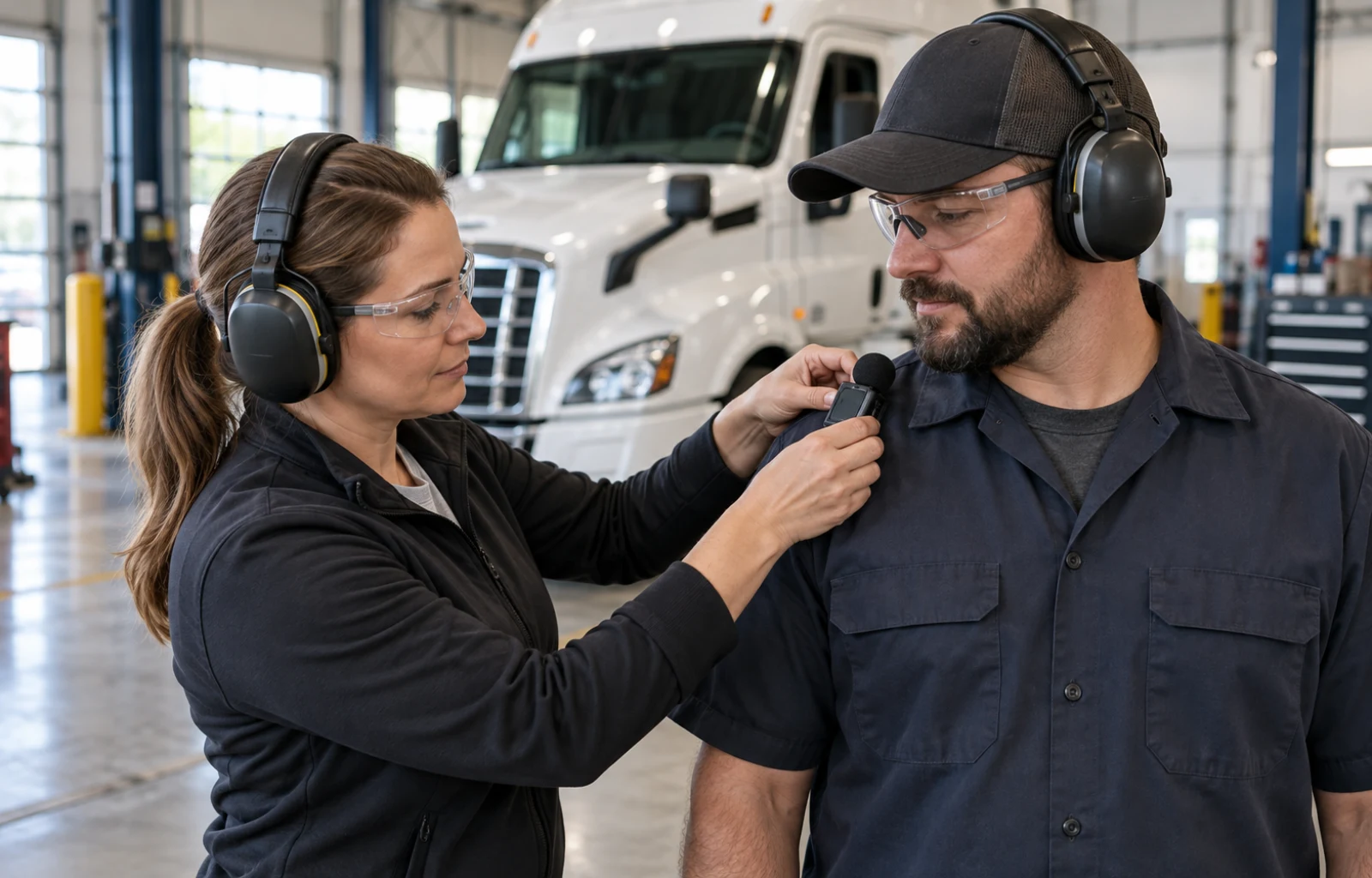
A fleet technician may move from a service bay to a parts counter and back beside another crew’s work. A noise reading taken at one quiet moment cannot describe that route. The useful shop question is how to assess the employee’s exposure across changing tasks. This resource examines existing federal general-industry guidance, rather than announcing a new noise rule or reporting measurements from a particular fleet. The suggested task map below is editorial analysis for planning a competent exposure assessment.
OSHA’s section 1910.95 requires a monitoring program when information indicates that an employee’s exposure may reach an eight-hour time-weighted average of 85 dBA. That is also the hearing-conservation action level; it is different from the table’s 90-dBA, eight-hour permissible exposure limit. The standard requires calibrated instruments. Where worker mobility, varying levels or impulse noise make area monitoring generally inappropriate, representative personal sampling is required unless the employer demonstrates equivalent area-sampling results. Our planning takeaway: choose the sampling method around the technician’s work pattern, rather than the easiest place to set a meter.
OSHA’s nonmandatory Appendix G explains the measurement distinction. A sound level meter measures a moment; estimating a workday requires readings across relevant times and places plus information about duration. A worn dosimeter integrates measurements over time as the worker moves. The appendix also identifies difficult normal conversation, employee complaints and machine-noise information as reasons to investigate exposure. These are prompts for an assessment, not measured proof that a particular shop exceeds a limit. Its guidance supports asking what happened during the shift before interpreting the resulting number.
Our suggested preparation is a simple task-and-location record made with the employees who actually do the work. List the bays visited, time spent on each task, nearby equipment operating at the same time and unusual assignments that day. Include work shared with another crew rather than recording only tools held by the sampled technician. Give the assessor this record so they can judge whether the selected day and workers represent the exposure being evaluated. A quiet inventory day should not silently stand in for a busy repair shift; the relevant question is what conditions the evidence describes.
Industry sponsor Turn safety guidance into repeatable fleet work.
See the connected TMS ↗
A phone can help identify a question without settling it. NIOSH describes its Sound Level Meter app as a tool for measuring workplace noise, while OSHA’s Technical Manual says smartphone noise apps can give rough local estimates but cannot document compliance with OSHA standards. Our recommendation is to retain the circumstances of an informal reading and refer it for appropriate evaluation. Do not turn a screenshot into a declaration that the whole shift is safe, or compare an unexplained app number directly with a regulatory time-weighted limit.
Close the assessment with a decision that reaches the affected workers. Section 1910.95 requires notification of employees exposed at or above the action level and repeat monitoring when specified changes raise exposure or may make hearing protection inadequate. Our proposed shop closeout names the assessed jobs, conditions covered, responsible reviewer and changes that should trigger another look. Keep those findings connected to the shop’s hearing-conservation process. A new compressor location, a different task mix or another crew working alongside the technician deserves review against the evidence already collected, rather than an assumption that the old assessment covers every future shift.