
Adding air to a truck tire is a service assignment
Adding air is covered tire servicing, too. Match the wheel and task to demonstrated training, usable safeguards and the tire’s operating history before assigning the work.
 Connect the records, conversations, and follow-up that keep a carrier moving.
See how it works ↗
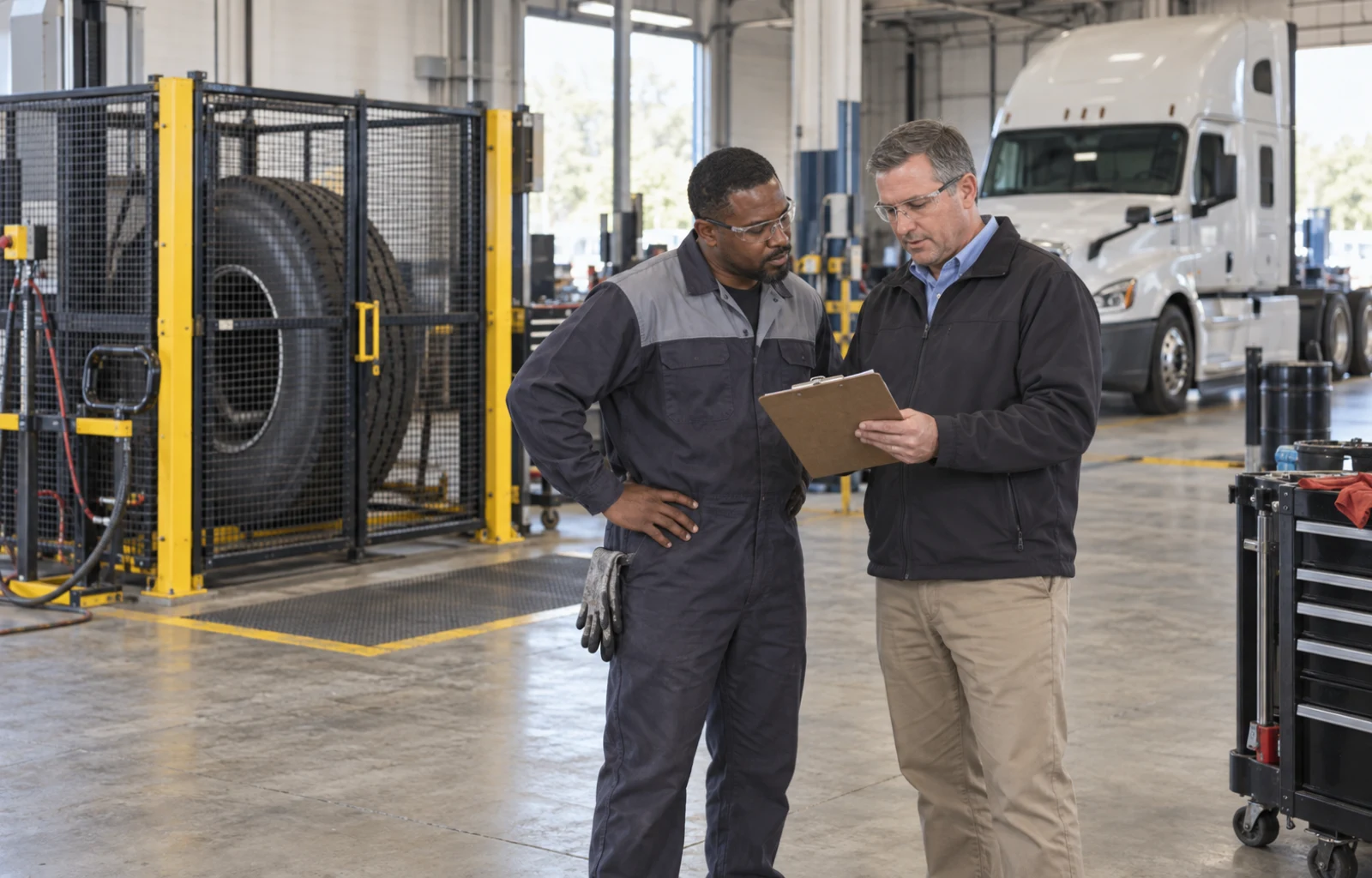
A driver who notices a low truck tire has identified a service need, not automatically earned permission to connect an air hose. For a fleet, the first useful question is who is trained for the actual wheel and task, with what equipment and instructions. OSHA's existing rim-wheel standard covers more than tire replacement: its definition of servicing includes inflation, deflation, installation, removal and handling. That makes a seemingly small assignment worth checking before someone acts. This resource explains the employer's service-assignment decision for covered large-vehicle wheels; it is not a tire-repair procedure, a new requirement or a substitute for practical training.
The coverage starts with the assembly, rather than a job title. Section 1910.177 applies to single-piece and multi-piece rim wheels on large vehicles including trucks, tractors, trailers and buses. It excludes automobile wheels and pickup or van wheels using automobile tires or tires designated LT; it also excludes workplaces governed by the listed longshoring, construction and agriculture standards. A multi-piece wheel has separate components, including a side or locking ring, while a single-piece wheel does not. Both are covered unless a provision says otherwise. A dispatcher should therefore describe the work and equipment accurately instead of assuming that only an old-style multi-piece wheel presents a servicing hazard. A CDL, familiarity with a truck and experience reporting tire pressure answer different questions from competence to perform this service.
For covered work, the employer must train employees in the hazards, the correct procedures for the wheel type and the applicable safe operating procedures. The standard goes beyond attendance: employees must demonstrate and maintain safe ability across the servicing tasks it lists, and the employer must evaluate that ability and provide more training when needed. Those tasks include component identification, use of restraints or barriers, on-vehicle single-piece inflation and understanding where to stand during inflation and the following inspection. Information must be taught in a way the employee can understand if the charts or manual cannot be read and understood. TruckingAssociation editorial guidance: when assigning work, ask a supervisor to confirm the person's demonstrated ability for that wheel and task, rather than relying on a course date or the word mechanic on a roster. A record can help locate that decision; it cannot make an untrained person ready.
Equipment readiness is a separate check. OSHA requires a restraint for inflating multi-piece wheels and a restraint or barrier for single-piece wheels unless the assembly will be bolted onto a vehicle during inflation. Its single-piece operating provisions specify fully tightened lug nuts for that on-vehicle condition. The air-line assembly must include a clip-on chuck, pressure gauge with an in-line valve or presettable regulator, and enough hose to let the worker remain outside the trajectory. That trajectory includes the possible path of components or an airblast, and is not limited to a straight line perpendicular to the wheel. The employer must have current charts or rim manuals available in the service area and use the recommended tools. Restraints and barriers require inspection before each day's use and after a separation or sudden air release; damaged equipment must be removed from service. A cage visible in a bay therefore does not, by itself, prove that the assignment is ready.
The tire's history can change the work before inflation begins. OSHA's published tubeless truck-and-bus chart warns against simply reinflating a tire operated at 80 percent or less of its recommended operating pressure; it calls for demounting, inspection and matching of components before reinflation in a restraint. The chart also addresses known or suspected damage. Those are instructions for trained servicing personnel, not a roadside invitation for a driver to remove a wheel. Editorial guidance: pass along the measured pressure, the applicable recommended pressure if known, whether the tire was driven low, any observed damage and the exact wheel position. Do not invent the missing history or treat a later recovered pressure as proof that internal condition is acceptable. When capability, condition or equipment is uncertain, keep the service decision with the trained supervisor or provider and follow the fleet's safe escalation plan.
A practical assignment review can now ask four concrete questions: which wheel assembly and service task are involved, who has demonstrated the required ability, which current instructions and safeguards apply, and what low-pressure or damage history must the technician know? This review is TruckingAssociation's editorial proposal, not an OSHA form or a complete service checklist. It works for a terminal shop and for arranging outside tire service because it asks about the actual work rather than the speed of the response. After service, the roadworthiness decision still needs its own evidence: FMCSA's tire guidance addresses defects, load restrictions and inflation pressure for vehicles in operation. A trained service assignment protects the people working on the wheel; an acceptable tire condition protects the next trip. Neither decision can be reduced to somebody adding air and saying the truck is ready.