
A voluntary shop respirator needs a type check
An employee’s own reusable respirator can bring different employer responsibilities from a disposable dust mask. First establish whether the use is truly voluntary.
 Build stronger carrier workflows without another disconnected spreadsheet.
Meet Pro FleetSync - TMS ↗
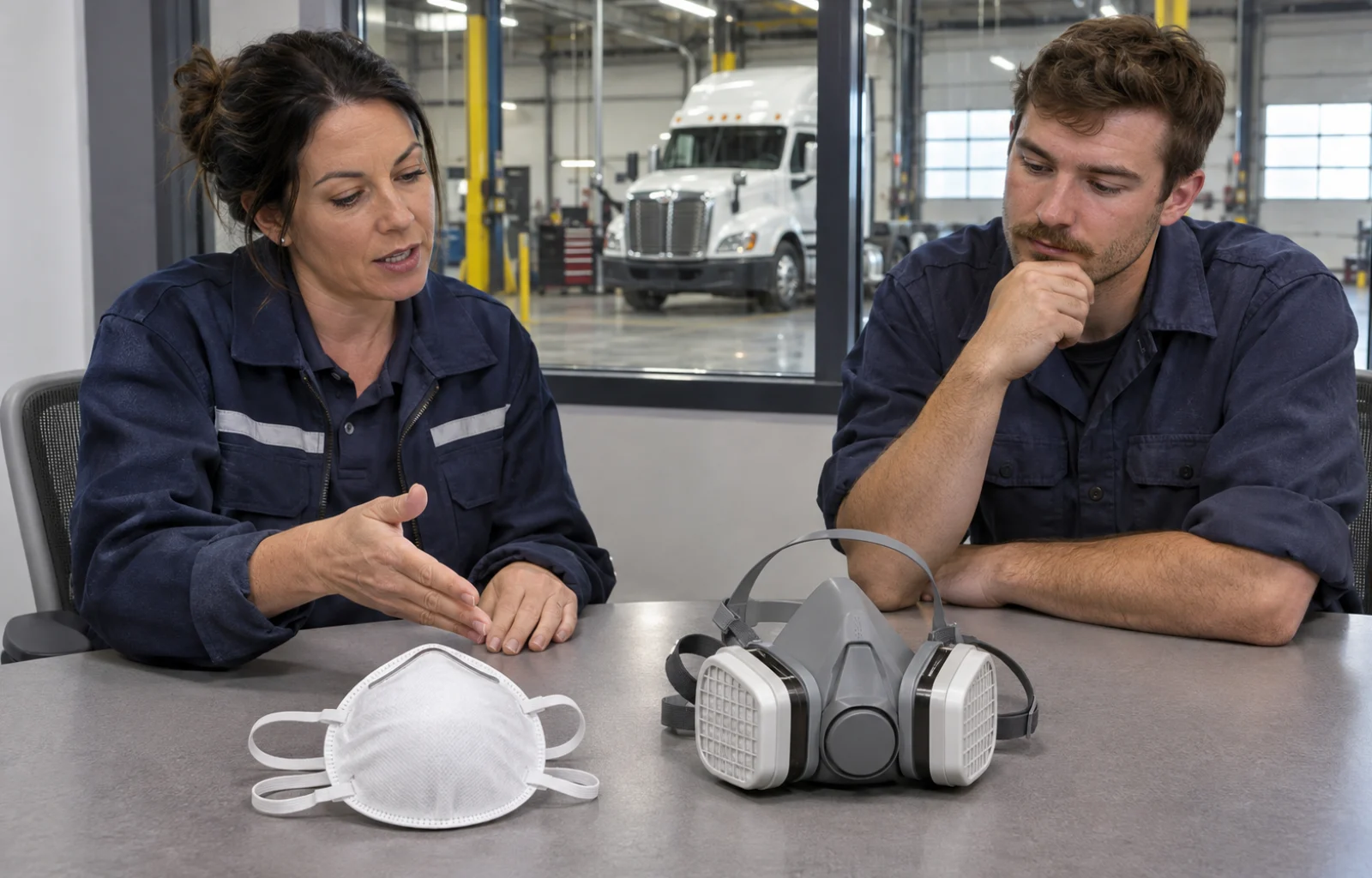
A technician brings a reusable respirator into the fleet shop and says wearing it is a personal choice. Another employee asks for a disposable dust mask. Can the supervisor handle both requests by distributing the same information sheet? OSHA’s voluntary-use provisions distinguish the equipment involved, and the answer begins even earlier: whether respiratory protection is actually optional for the work. This resource explains existing federal general-industry requirements, verified for this edition. It does not report a new rule or assess conditions at any particular shop.
First establish the exposure and the employer’s instructions. OSHA’s April 26, 2018 interpretation explains that paying for a respirator does not by itself make its use mandatory. But a requirement in an OSHA standard, or an employer instruction requiring employees to wear one, makes a difference. A supervisor cannot turn required protection into voluntary use by calling the equipment a comfort item. Our editorial recommendation is to have the person responsible for workplace exposure assessment resolve that classification before approving a request. An employee supplying the equipment does not settle the question either.
For genuinely voluntary use, identify the device. OSHA’s April 24, 2018 interpretation distinguishes filtering facepieces, whose filtering material is integral to the facepiece, from reusable elastomeric respirators with replaceable filters or cartridges. When employees use only filtering facepieces voluntarily, the employer must determine that their use will not create a hazard and provide each user with Appendix D. OSHA explains that this situation does not require those employees to be included in a written respiratory protection program. That limited exception should not become a blanket shop policy covering every device that someone calls a dust mask.
Voluntary use of an elastomeric respirator brings additional responsibilities. The employer must implement the written-program elements needed to ensure the user is medically able to wear it and that cleaning, storage and maintenance prevent the device itself from creating a health hazard. OSHA’s April 26 interpretation also says required medical evaluations for these voluntary users are at the employer’s expense, with appropriate time and facilities for care. It distinguishes this from fit testing: voluntary use in nonhazardous atmospheres does not require a fit test. That exception cannot be carried into an assignment where respirator use is required.
Appendix D gives the employee information that belongs in the conversation, even when use is optional. It addresses manufacturer instructions, equipment limitations, suitable certification and keeping track of one’s own respirator. A particulate device must not be assumed suitable for gases or vapors. Our suggested shop handoff is to review the actual model and instructions together, rather than hand over a sheet without checking what the employee brought. This is an editorial management suggestion, not an extra federal form. Nor is it a cartridge-selection guide for painting, welding or other specialized work.
NIOSH’s current selection guidance places respiratory protection within the hierarchy of controls and stresses correct fit, use and manufacturer-directed care. Where protection is necessary, its guidance describes a complete respiratory protection program, including medical evaluation, fit testing and training. For a hypothetical shop that changes from an assessed low-exposure task to different materials or processes, our recommendation is to revisit the exposure decision before continuing under the old voluntary arrangement. The useful supervisor check is concrete: is use required, which respirator is involved, and who has arranged the applicable information, medical review and care? Resolve those responsibilities before treating an employee-owned device as ready for the job.