
A small eyewash bottle does not finish the splash plan
Emergency flushing readiness depends on the exposure, the equipment and the route to it. A bottle on the shop wall does not answer all three questions.
 Connect the records, conversations, and follow-up that keep a carrier moving.
See how it works ↗
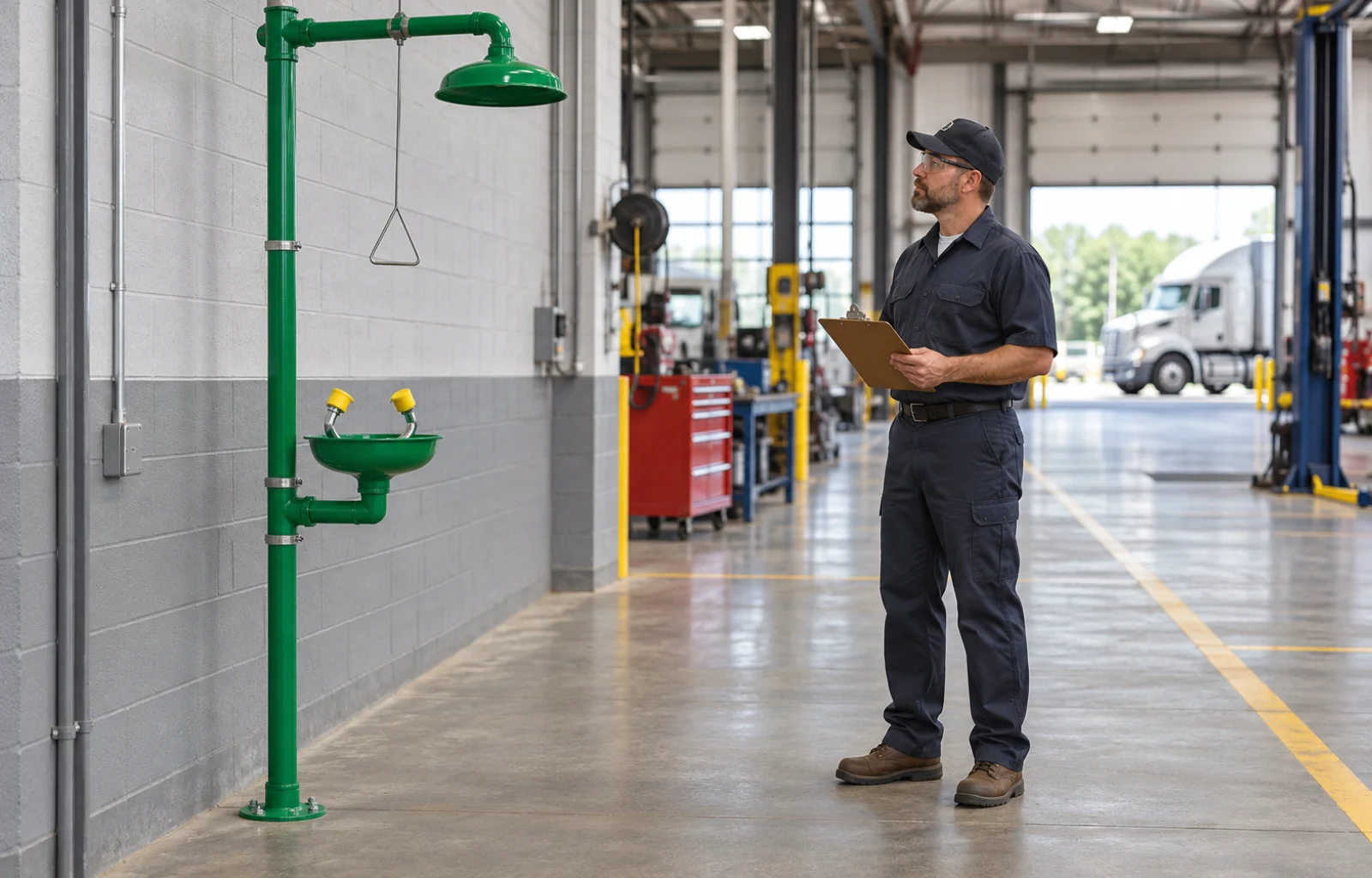
A fleet shop has a small eyewash bottle beside its first-aid supplies. Does that settle preparation for a corrosive splash? The useful question is whether the workplace has suitable emergency flushing equipment for the exposure that can actually occur, available when someone needs it. This resource examines existing federal general-industry requirements and technical guidance, verified for this edition. It announces no new rule and does not prescribe treatment for an individual injury. The practical issue reaches truck maintenance bays, terminal cleaning areas and delivery work involving corrosive materials.
OSHA’s 29 CFR 1910.151(c) requires suitable emergency drenching or flushing facilities within the work area when someone’s eyes or body may be exposed to injurious corrosives. The rule concerns possible exposure, not simply whether a business owns chemicals. Our suggested starting point is a task review: identify the actual product, concentration, handling method and body areas that could be contacted. Have the person responsible for workplace safety review the current safety data sheet and the work itself before selecting equipment. An inventory entry alone cannot show what happens when a worker opens, transfers or services a container.
OSHA’s June 2009 interpretation distinguishes the corrosive-material trigger in that paragraph from products that are irritants without being corrosive. It also explains why sealed packaging needs a realistic assessment: material that cannot expose workers differs from a system they must open, sample or draw from. For a hypothetical shop switching from ready-to-use cleaner to a concentrated product, our recommendation is to reassess before the new handling begins. That is an editorial change-control suggestion. It is not a claim that every cleaning product triggers the same federal requirement or that other hazards can be ignored.
The Canadian Centre for Occupational Health and Safety distinguishes personal wash units from stations capable of sustained flushing. Its guidance says personal units do not replace a station with a 15-minute supply. It describes self-contained equipment as an alternative to plumbing when installed and maintained according to manufacturer instructions and suitable performance criteria. This is technical guidance, not Canadian law applied to a U.S. shop. The purchasing lesson is to check the actual device’s purpose and capability. “Portable” can describe very different equipment; a small hand-held bottle and a purpose-built self-contained station are not interchangeable merely because neither has a pipe connection.
Access is a separate decision. In a 2007 interpretation addressing corrosive deliveries, OSHA explains that a locked door between an exposed worker and flushing facilities would ordinarily present an accessibility problem. It also says the delivery employer retains responsibility if customer facilities are unsuitable or unavailable. That gives fleets a concrete question for after-hours work: can this employee reach appropriate equipment while doing this assignment? Our editorial recommendation is to confirm the arrangement with the receiving location before the task, including actual access conditions. A facility shown on a site plan does not establish that the night driver can use it.
Readiness continues after installation. CCOHS recommends regular inspections and manufacturer-directed maintenance, including attention to self-contained fluid expiry. It recommends training workers to find and operate the equipment. Our proposed shop check is therefore a walk through the real route, a review of the unit’s service instructions and an assigned person to resolve defects. Consider a hypothetical cart parked across the approach or an expired fluid cartridge: owning the equipment has not resolved the operating problem. Do not use this article as an equipment certification; obtain a qualified assessment of suitability, installation and applicable state requirements.
Keep prevention and response connected. OSHA’s 2007 letter explains that protective equipment aims to prevent injury, while flushing facilities limit injury when protection fails. Neither substitutes for the other. Before the next corrosive-handling assignment, our suggested handoff is a verified exposure assessment, suitable protection, an accessible flushing arrangement and employees who know the response procedure. If any part remains uncertain, resolve it before starting the work. The bottle on the wall can be an inventory item; emergency readiness has to describe what the worker can actually reach and use.