
A shoulder stop needs a warning plan, not just flashers
Federal rules distinguish the kit a truck carries from the signals a driver places after a stop. The road layout, sight line, and traffic exposure change the response, while a 2026 rule removed an obsolete flare option.
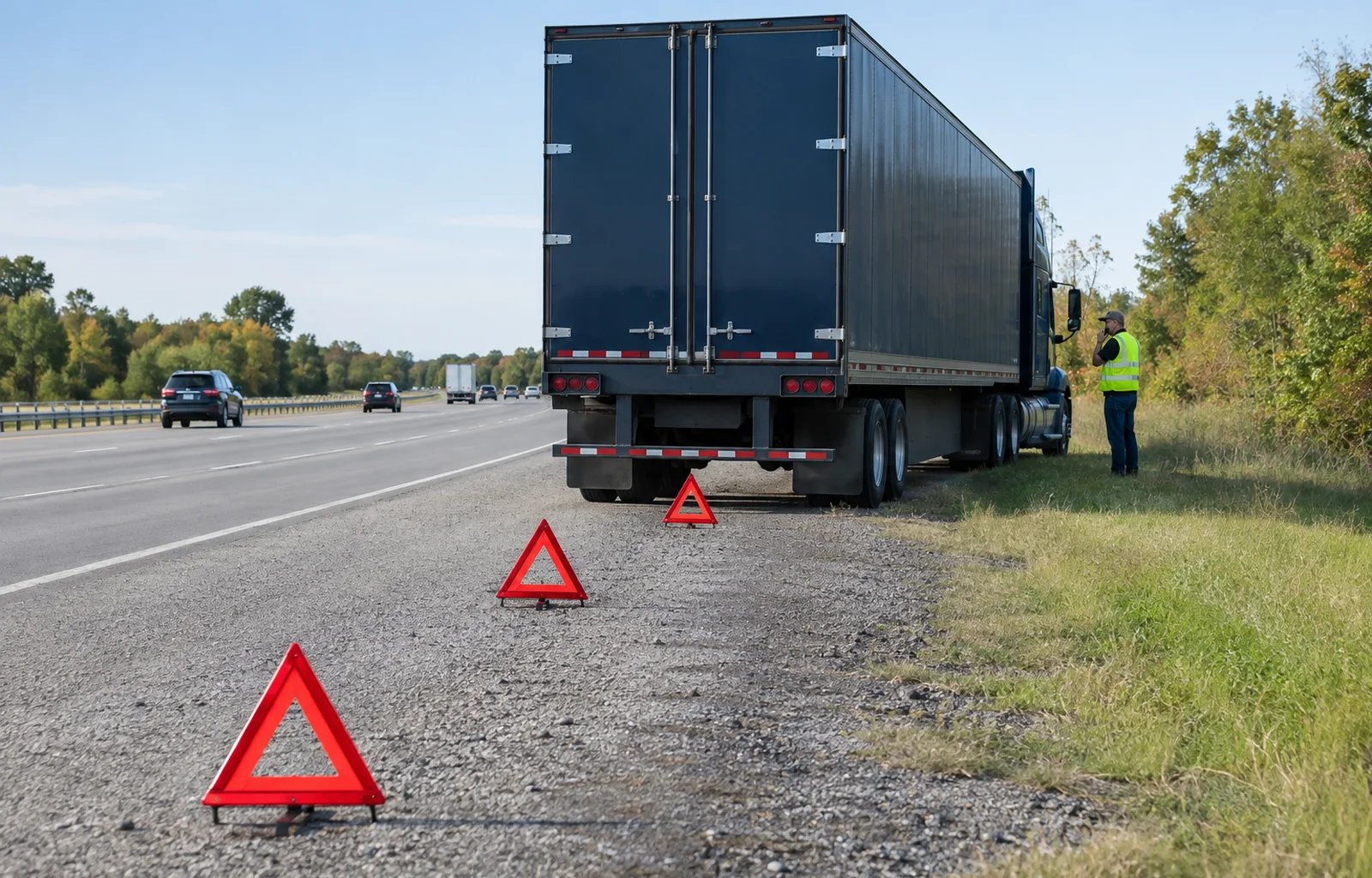
A commercial truck can be visible from its cab and still be hard for approaching traffic to interpret in time. When it is stopped on a highway's traveled portion or shoulder for a reason other than a necessary traffic stop, federal rules create two linked duties: activate the vehicle's hazard flashers immediately and place the required external warning devices as soon as possible, no later than 10 minutes. Flashers continue until the devices are placed and are used again while the devices are collected before moving. This resource is a current-rule explainer and an editorial planning tool for fleets; it is not a claim that a particular roadside scene can be made safe by following one diagram.
Start with the equipment actually in the power unit. Section 393.95 generally requires three bidirectional reflective triangles meeting the federal vehicle standard, or at least six fusees, with more fusees if needed to maintain the prescribed signals. Other warning equipment can supplement the required devices but does not automatically replace them. A final FMCSA rule effective March 23, 2026 removed liquid-burning flares from the listed federal options because the agency considered that language obsolete. Some older agency training pages still mention them, so a carrier updating its kit card should check the current rule and the final rule rather than copy an old checklist. FMCSA has granted specific alternatives by exemption; an ordinary LED beacon is not, on that fact alone, a blanket substitute for the required kit.
The first roadside decision is about exposure, not paperwork. Bring the vehicle to the safest attainable position without creating a new hazard, activate the flashers, assess traffic, the shoulder, visibility, and any fuel or cargo problem, and request emergency or road-service help when the situation calls for it. FHWA's traffic-incident guidance treats passing traffic and sudden changes upstream as hazards to people at a scene. Editorial inference: fleets should train drivers to report a dangerous placement path and get assistance rather than turning a 10-minute rule into a blind walk beside moving vehicles. That report does not erase the federal requirement; it gives dispatch and responders a truthful account of the hazard and what help is needed.
On a two-way road under the general placement pattern, the near device goes on the traffic side roughly 10 feet from the stopped truck toward approaching traffic. A second goes about 100 feet toward approaching traffic in the occupied lane or shoulder, and a third about 100 feet in the opposite direction. These are positions in section 392.22, not a universal instruction to cross live lanes. The driver needs to recognize where traffic actually approaches and whether the occupied space can be reached safely. Editorial inference: practice with a diagram before a breakdown, then adapt the response to the real road and summon traffic control when the scene cannot be worked safely.
Industry sponsor Keep drivers, dispatch, safety, and maintenance working from one operating view.
Explore Pro FleetSync ↗
Keep drivers, dispatch, safety, and maintenance working from one operating view.
Explore Pro FleetSync ↗
A divided or one-way road changes the geometry: all three devices warn traffic coming from behind, with one on the traffic side within 10 feet of the rear and the other two roughly 100 and 200 feet upstream in the occupied lane or shoulder. If a curve, hillcrest, or other obstruction limits the view within 500 feet, the rule calls for a warning signal 100 to 500 feet toward that obstruction to give approaching road users ample warning. The relevant question is therefore not simply 'Did the driver put out three triangles?' It is whether the selected positions fit the road direction and sight line without exposing a person to an unmanaged traffic hazard.
There is a limited municipal exception that is easy to overstate. Section 392.22 does not require device placement in a municipality's business or residential district unless lamps are required and street or highway lighting is insufficient to make the truck clearly discernible from 500 feet. That is a conditional rule, not a general exemption for city streets or for every daylight stop. Likewise, an FMCSA waiver for specified automated-driving operations does not change the ordinary kit and placement rule for a human-driven fleet. Editorial inference: a fleet decision aid should ask where the stop is, whether lamps are required, and what a road user can see, instead of using 'urban' or 'automated' as a shortcut.
Fusees create a separate hazard decision. Section 393.95 forbids flame-producing signals on specified explosives loads, certain flammable-gas or flammable-liquid cargo tanks even when empty, and commercial vehicles fueled by compressed gas. Section 392.22 also restricts lighting a flame signal near leaking flammable or combustible material. A truck equipped only with permissible fusees must keep one burning at each prescribed location while stopped and remove them before moving. Editorial inference: standardizing on compliant reflective triangles can simplify a mixed fleet's inventory, but the fleet still needs to inspect the devices, know any approved exemption it uses, and train the correct placement patterns.
Close the event with the same care used to open it. A useful dispatch handoff records the precise location and travel direction, whether the truck occupies a lane or shoulder, traffic speed and sight limits, the stop's cause, the warning devices carried and placed, the time of placement, any unsafe access, and the assistance requested. The driver should maintain the warning as the scene changes, use flashers while retrieving devices, and move only when the vehicle and roadway can be used safely. This is an editorial operating sequence, not a substitute for current regulations, responders' directions, or a site-specific safety judgment. Its value is that the next person can see both the rule decision and the exposure the driver actually faced.